◆ At a Glance
◆ Best For
◆ Overview
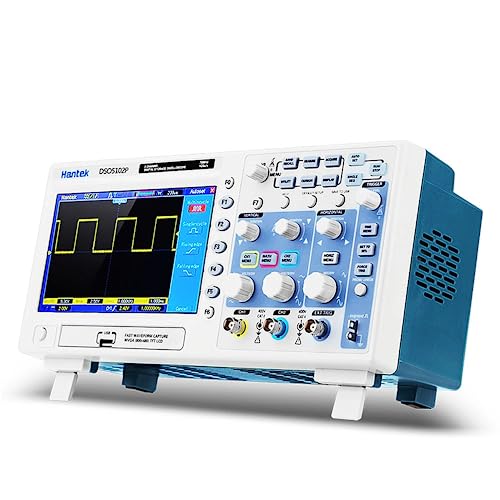
The Hantek DSO5072P used to occupy a specific position in the budget oscilloscope market: it was one of the cheapest ways to get a traditional benchtop oscilloscope that looks and operates like the instruments you see in professional labs and YouTube teardown videos. That recommendation only holds when you find it below about $200. At current marketplace pricing near $455, the value case falls apart.
The appeal here is still form factor and familiarity. If you have watched EEVblog or read electronics textbooks, the instruments pictured have rotary encoders, dedicated channel buttons, and trigger controls laid out in a specific way. The DSO5072P follows that convention. You learn muscle memory that transfers directly to more expensive scopes later.
But the DSO5072P has two problems that are genuinely difficult to overlook: current price drift and 40Kpt memory depth. That memory figure is not just low by modern standards — it is low by 2015 standards. At today's price, you should skip it unless you find a deep discount.
◆ Pros & Cons
Pros
- Traditional benchtop form factor — looks and feels like a real scope
- 70MHz bandwidth handles most hobbyist signals without complaint
- Traditional bench layout is useful if you find it discounted below $200
- Simple, button-based interface is easy to learn
Cons
- Only 2 channels limits simultaneous signal debugging
- 40Kpt memory depth is embarrassingly shallow by modern standards
- No protocol decoding — SPI and I2C debugging is impossible
- Fan can be noisy enough to notice in a quiet room
- No software update path to improve functionality
You'll Also Need
Common accessories that pair well with this scope.
Hantek PP-200 200MHz Probe Set (2x)
Replacement 200MHz passive probes compatible with most bench scopes
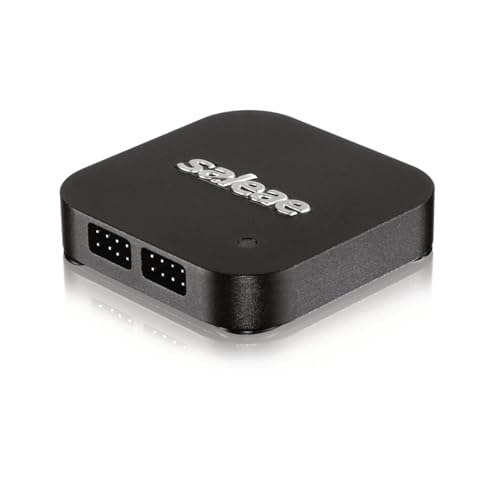
Buy on Amazon · $18 →DEVMO USB Logic Analyzer 8-Channel
8-channel logic analyzer for debugging digital signals and protocols
Buy on Amazon · $14 →Coaxial BNC Cable 50Ω (3-pack)
BNC to BNC 50Ω coax cables for signal connections
Buy on Amazon · $12 →◆ More Bench Gear We've Reviewed
Beyond the scope: other instruments hobbyists keep on the bench.
See signals in the frequency domain
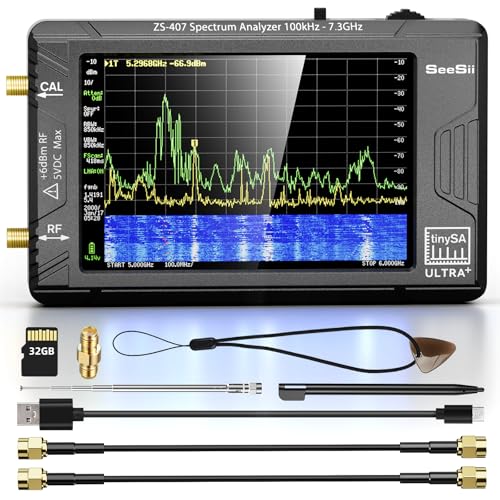
TinySA Ultra
$260.9
See all see signals in the frequency domain picks →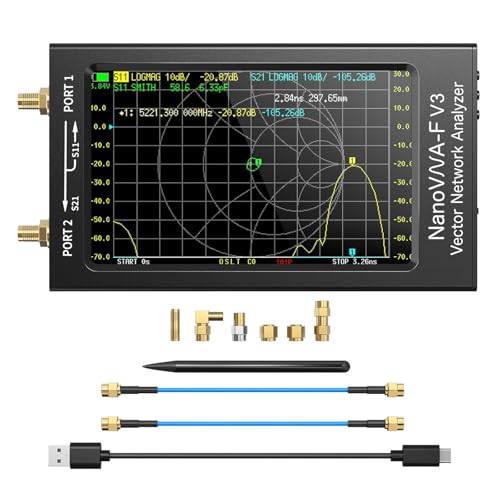
Sweep RF and antenna performance
NanoVNA-F V3
$299.99
See all sweep rf and antenna performance picks →Hantek DSO5072P
Prices may change · Free shipping with Prime
◆ Design & Build Quality
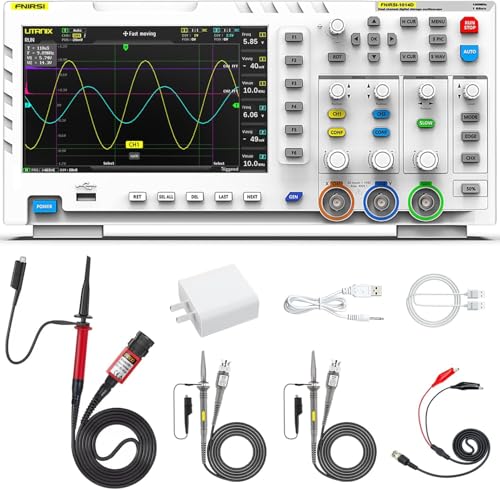
The Hantek DSO5072P is a conventional benchtop oscilloscope measuring 312 x 152 x 120mm and weighing 2.0kg. It has the standard form factor: display on the left, knobs and buttons on the right, BNC connectors on the front panel. The plastic enclosure is reasonably solid for the price, feeling sturdier than the FNIRSI 1014D's tablet shell but noticeably lighter and less rigid than a Rigol DS1054Z.
The 7-inch TFT LCD is non-touch, which is standard at this price for a benchtop scope. The display is adequate for viewing two-channel waveforms with sufficient brightness for a well-lit workbench. Viewing angles are limited, as expected from a TFT panel. If you are accustomed to the IPS displays on newer Rigol DHO series scopes, this will look washed out from off-axis positions.
The physical controls follow the standard oscilloscope layout: vertical position and scale knobs for each channel, horizontal position and time base knobs, and a trigger level knob. Buttons provide access to menus, measurements, and utility functions. The knobs have reasonable detent feel — not as smooth as Rigol's encoders, but functional. The button presses are clicky and positive.
The fan is worth mentioning because you will hear it. In a quiet room, the DSO5072P's fan produces a noticeable hum that some users find distracting. It is not loud enough to be a problem in a workshop or shared lab space, but in a quiet home office it can be an annoyance. The Rigol DS1054Z has a similar fan noise issue, so this is common at the benchtop budget tier.
Probe quality is basic. The included probes are functional 1x/10x passive probes that get the job done for hobbyist work, but they are not the quality you would get with Rigol or Siglent stock probes. Budget for aftermarket probes if you need better performance.
◆ Performance & Specifications Deep Dive
The DSO5072P provides 70MHz bandwidth at 1GSa/s sample rate across 2 channels. The 70MHz bandwidth is sufficient for the vast majority of hobbyist work. Arduino Uno and Mega signals run at 16MHz with edge rates well within 70MHz. Most SPI communication at typical clock rates (1-8MHz) is comfortably within range. PWM signals, audio circuits, basic RF filtering, and power supply debugging all fall under this bandwidth umbrella.
Where 70MHz starts to limit you: if you are working with ESP32 or Raspberry Pi Pico running SPI at 20MHz+, the scope's bandwidth rolloff means you will not see accurate rise times on the clock edges. If you are doing any RF work above simple crystal oscillator verification, 70MHz is insufficient. The Siglent SDS1202X-E at $379 gives you 200MHz, which provides meaningful headroom for faster signals.
The 1GSa/s sample rate is reasonable for 70MHz bandwidth. At 5x oversampling relative to bandwidth, you get adequate waveform fidelity for the signals this scope can resolve. You will not see aliasing artifacts on signals within the bandwidth specification.
Now, the 40Kpt memory depth. This is the specification that defines the DSO5072P's limitations and the primary reason we struggle to give it a strong recommendation. At 1GSa/s with 40,000 sample points, you get 40 microseconds of capture at full sample rate. That is 40 microseconds. A complete I2C transaction reading a sensor register at 400kHz takes approximately 50-100 microseconds. A UART byte at 9600 baud takes about 1 millisecond. A complete serial message can take tens of milliseconds.
To capture these longer events, the scope must reduce its sample rate, which degrades waveform quality and can miss fast transients. The FNIRSI 1014D around $170 has 240Kpt — six times more memory than this scope and usually costs slightly less. The Rigol DS1054Z at $349 has 12Mpt — 300 times more. The Siglent SDS1202X-E at $379 has 14Mpt — 350 times more. The DSO5072P's memory depth is its most significant weakness.
Trigger types include Edge, Pulse, Video, Slope, and Overtime. The Overtime trigger is somewhat unusual at this tier and allows triggering when a signal stays above or below a threshold for a specified duration. It is a modest advantage over the FNIRSI 1014D's trigger set, though far short of the DS1054Z's comprehensive trigger menu.
◆ Software & User Experience
The DSO5072P uses a traditional button-and-menu interface that follows standard oscilloscope conventions. You press a channel button to access its coupling, bandwidth limit, probe ratio, and invert settings. The Trigger menu gives you type selection, source, and level. The Acquire menu controls sample rate and memory depth settings. The Display menu handles persistence, grid brightness, and waveform intensity.
Menu navigation is straightforward if you have used any modern digital oscilloscope. If you have not, the button layout follows the same conventions used by Agilent, Tektronix, and every other oscilloscope manufacturer, so any oscilloscope tutorial online will translate directly to this scope's interface. This is an underappreciated advantage of the traditional benchtop form factor.
Automatic measurements are available for voltage (Vpp, Vmax, Vmin, Vavg, Vrms), time (frequency, period, rise time, fall time, duty cycle), and basic math operations. You can display multiple measurements simultaneously on the right side of the screen. The measurement accuracy is reasonable for a budget scope, though you should expect +/-3% on voltage measurements rather than the +/-1% you would get from Siglent or Rigol.
The math functions include channel addition, subtraction, multiplication, and FFT. The FFT display is basic but functional for identifying dominant frequency components. The FFT window options are limited compared to mid-range scopes.
The scope has no protocol decoding capability whatsoever. There is no SPI decoder, no I2C decoder, no UART decoder. If you need to analyze serial communication, you will need an external logic analyzer or a scope that includes decoding. The Rigol DS1054Z at $349 includes SPI, I2C, UART, and RS232 decoding. Even the $110 FNIRSI DPOX180H includes protocol decoding.
PC connectivity is available through USB, and Hantek provides basic software for waveform capture and screenshot export. The software is functional but dated, and it does not approach the quality of Siglent's SPL scripting environment or Rigol's UltraScope software.
◆ Protocol Decoding & Advanced Features
The DSO5072P has no protocol decoding capability. This is a significant omission in the current market where even $110 handheld scopes from FNIRSI include basic SPI, I2C, and UART decoding.
The absence of protocol decoding means that if you are debugging embedded systems — which is one of the most common hobbyist oscilloscope use cases — you cannot view decoded data overlaid on your waveforms. You will see the raw digital pulses of an I2C transaction, but the scope cannot tell you that the address byte was 0x48 and the data byte was 0x1A. For this, you need either a scope with decoding (DS1054Z, SDS1202X-E, DHO924S) or a standalone logic analyzer.
The scope does not include a function generator. This means you need a separate signal source for testing and learning. The FNIRSI 1014D around $170 includes a built-in function generator, as does the OWON HDS2202S around $309 and the Rigol DS1104Z-S Plus at $549. For a beginner who does not already own a function generator, the DSO5072P's lack of one means additional cost.
Advanced trigger modes are limited. You get Edge, Pulse, Video, Slope, and Overtime triggers. Missing from the list are Pattern, Duration, Runt, Window, Setup/Hold, and Nth Edge triggers — all of which the Rigol DS1054Z provides at $349. The DSO5072P's trigger set is adequate for basic work but limits your ability to isolate specific events in complex signals.
There is no WiFi connectivity, no waveform recording/playback, no mask testing, and no segmented memory acquisition. These are features found on mid-range and premium scopes, and while their absence is expected on a discounted entry-level bench instrument, it reinforces the DSO5072P's position as a basic instrument.
◆ Real-World Use Cases
For Arduino and basic microcontroller work, the DSO5072P does the job. Verifying PWM output frequencies, checking that a voltage regulator is providing stable power, and confirming that a signal is present on a GPIO pin are all straightforward tasks. The 70MHz bandwidth is more than sufficient for signals running at Arduino clock speeds, and the benchtop form factor means the scope stays put on your desk with easy-to-reach knobs.
For audio electronics, the scope is adequate. Audio frequencies are trivially within the bandwidth, and the two channels let you view input and output simultaneously. Measuring gain, checking for clipping, and verifying filter rolloff are all possible. The limited memory depth is less of a concern at audio frequencies because the sample rate requirement is much lower.
For power supply design and testing, the scope is marginal. You can verify that a switching regulator is oscillating at the expected frequency and see the general waveform shape, but the vertical resolution and noise floor make it difficult to accurately measure small ripple voltages. For serious power supply work, a scope with lower noise floor specifications is worth the investment.
For embedded serial protocol debugging, the DSO5072P is frustrating. Without protocol decoding, you can see that data is being transmitted on an I2C or SPI bus, but interpreting that data requires manual effort. The 40Kpt memory depth compounds the problem: you often cannot capture a complete transaction at full sample rate. If serial protocol debugging is a primary use case, this is not the right scope.
For learning oscilloscope operation, the DSO5072P is genuinely valuable. The traditional benchtop layout with dedicated knobs and buttons teaches you the standard oscilloscope interface that has been used for decades. Skills you develop on this scope transfer directly to any professional scope. This is a real advantage over tablet-style scopes like the FNIRSI 1014D, whose touchscreen interface does not prepare you for professional instruments.
◆ Who Should Buy This (And Who Shouldn't)
Buy the Hantek DSO5072P only if you find it below about $200 and specifically want a traditional benchtop interface. The rotary encoders, dedicated buttons, and conventional layout build muscle memory that transfers to professional instruments. If you are learning electronics in a structured way and want your bench to look and function like a proper workstation, the DSO5072P can still provide that experience on sale.
Buy it only if your primary work involves slow signals — audio circuits, basic power supply verification, Arduino PWM — where the 40Kpt memory depth is less of a constraint. At lower sample rates, the memory depth provides adequate capture windows.
Do not buy the DSO5072P at current marketplace pricing near $455. That puts it above the DS1054Z and close to the DHO804, both of which are far better first-scope choices.
Do not buy the DSO5072P if memory depth matters to your work. At 40Kpt, this scope has less capture memory than the FNIRSI 1014D (240Kpt), and dramatically less than the Rigol DS1054Z (12Mpt). If you are capturing serial transactions, long analog events, or using zoom-and-scroll waveform analysis, the memory depth makes this scope genuinely painful to use.
Do not buy it if you need protocol decoding. The complete absence of SPI, I2C, and UART decoding is a hard limitation.
Do not buy it if you can stretch to $349 for the Rigol DS1054Z. Four channels, 12Mpt memory, protocol decoding, advanced triggers, and massive community support make the DS1054Z a fundamentally different instrument. Every forum and Reddit thread about beginner oscilloscopes will tell you the same thing: save for the Rigol.
◆ Alternatives Worth Considering
The FNIRSI 1014D at about $169.99 is the direct budget competitor. It provides 100MHz bandwidth, includes a touchscreen and built-in function generator, and has 240Kpt memory depth (versus the DSO5072P's 40Kpt). The trade-off is the tablet form factor and lower build quality. For pure specifications, the FNIRSI offers more for less when the Hantek is not deeply discounted.
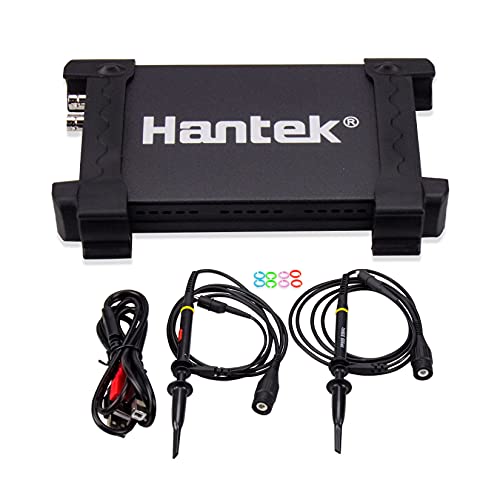
The Hantek 6022BE around $85 is Hantek's own USB-based alternative. It requires a PC to operate and its 20MHz bandwidth is severely limiting, but if budget is the primary constraint, it provides basic oscilloscope functionality at the lowest possible cost.
The Rigol DS1054Z at $349 is the scope that makes the DSO5072P a hard recommendation. You get 4 channels, 12Mpt memory (300x deeper), protocol decoding, advanced triggers, and the largest hobbyist community of any oscilloscope. The DS1054Z is the default recommendation in every electronics forum for good reason.
The Rigol DHO804 at $439 is the modern touchscreen alternative. If the DSO5072P listing is near $455, the DHO804 is the cleaner buy by a wide margin.
The Rigol DHO924S around $899 is the premium benchmark. 250MHz bandwidth, 4 channels, 50Mpt memory, IPS touchscreen, WiFi, and protocol decoding. It is not the budget substitute, but it is the step-up if you know you need serious bandwidth.
Our Verdict
The Hantek DSO5072P only makes sense as a budget benchtop scope when you find it below about $200. At the current marketplace price near $455, skip it. The 70MHz bandwidth and 7-inch display are fine for basic analog checks, but the 40Kpt memory depth is almost unusably shallow next to modern alternatives, and there is no protocol decoding for SPI or I2C. If you need a real first scope, the Rigol DS1054Z gives you 4 channels, deep memory, protocol decoding, and far better community support for less money. If you want a modern touchscreen workflow, the Rigol DHO804 is the cleaner buy.
Hantek DSO5072P
$454.89
Prices may change · Free shipping with Prime
◆ Full Specifications
| Full Specifications | |
|---|---|
| Bandwidth | 70MHz |
| Sample Rate | 1GSa/s |
| Channels | 2 |
| Memory Depth | 40 Kpts |
| Display Size | 7" |
| Display Type | TFT LCD |
| Form Factor | Benchtop |
| Weight | 2kg |
| Dimensions | 312 x 152 x 120 mm |
| Protocol Decoder | No |
| Function Generator | No |
| WiFi | No |
| Battery Option | No |
| Trigger Types | Edge, Pulse, Video, Slope, Overtime |
◆ Frequently Asked Questions
Is the Hantek DSO5072P good for beginners?
Can the DSO5072P decode SPI, I2C, or UART?
Why is the 40Kpt memory depth a problem?
Is the fan noise noticeable?
Does the DSO5072P include a function generator?
How does the DSO5072P compare to the FNIRSI 1014D?
Can I use this scope for automotive diagnostics?
Should I buy the DSO5072P or save for the Rigol DS1054Z?
◆ Related Buying Guides
Compare With Similar Scopes
◆ Head-to-Head Comparisons
Hantek DSO5072P
$454.89
Prices may change · Free shipping with Prime
Owner Notes
From the Bench
I Tested My USB Scope Against a $60 Logic Analyzer on I2C — Here's What Happened
Head-to-head: the Hantek DSO5072P (USB scope) versus the Innomaker LA1010 (budget logic analyzer) debugging I2C pull-up failures. One tool won immediately.
I Used a USB Oscilloscope for 3 Years and Didn't Know What I Was Missing
USB oscilloscopes like the Hantek DSO5072P are affordable and portable, but they crumble when you need to decode digital protocols. I found out the hard way.