◆ At a Glance
◆ Best For
◆ Overview
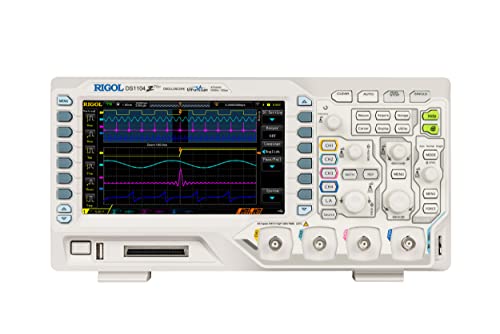
The Rigol DS1104Z-S Plus is the DS1054Z with the training wheels removed and a function generator bolted on. At roughly $699, it provides 100MHz bandwidth (no hack required), 4 channels, 12Mpt memory depth, protocol decoding, the same comprehensive trigger set, and a built-in 25MHz function generator. It is the premium version of the most recommended hobbyist oscilloscope platform ever made.
The problem with the DS1104Z-S Plus in 2026 is not the scope itself — it is the Rigol DHO924S. The DHO924S costs about $899, roughly $200 more, and provides 250MHz bandwidth, 50Mpt memory, an IPS touchscreen, WiFi, a function generator, and CAN/LIN decoding. On paper, the DHO924S is better in every measurable way if your budget can stretch. That comparison defines whether the DS1104Z-S Plus is still a rational purchase.
This review exists to help you decide whether the DS1000Z platform's proven reliability and established community justify saving about $200 versus the DHO924S, which beats it on raw specifications but has a shorter track record.
◆ Pros & Cons
Pros
- 100MHz bandwidth with 4 channels — no bandwidth hack needed
- Built-in 25MHz function generator saves desk space and cost
- Same excellent trigger set as the DS1054Z
- Protocol decoding (SPI, I2C, UART) included
- Proven platform for teaching labs that need scope plus signal generator
Cons
- At ~$699, it is no longer the obvious value play next to newer touchscreen scopes
- Same dated interface as the DS1054Z — no touchscreen
- No WiFi or CAN/LIN decoding at this price
- The DS1000Z platform is aging compared to the DHO series
You'll Also Need
Common accessories that pair well with this scope.
Hantek PP-200 200MHz Probe Set (2x)
Replacement 200MHz passive probes compatible with most bench scopes
Buy on Amazon · $18 →DEVMO USB Logic Analyzer 8-Channel
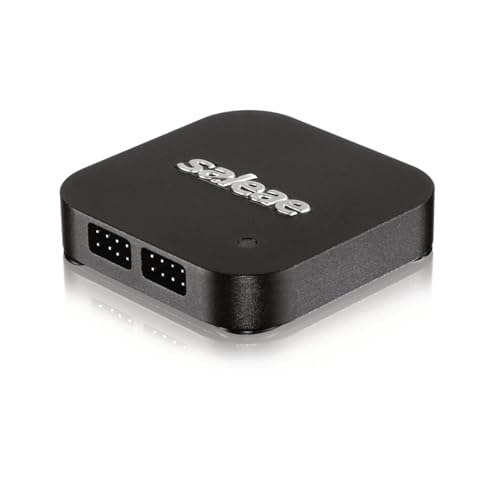
8-channel logic analyzer for debugging digital signals and protocols
Buy on Amazon · $14 →Coaxial BNC Cable 50Ω (3-pack)
BNC to BNC 50Ω coax cables for signal connections
Buy on Amazon · $12 →◆ More Bench Gear We've Reviewed
Beyond the scope: other instruments hobbyists keep on the bench.
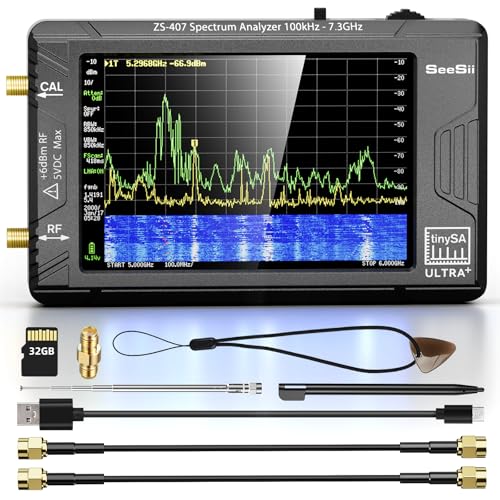
See signals in the frequency domain
TinySA Ultra
$260.9
See all see signals in the frequency domain picks →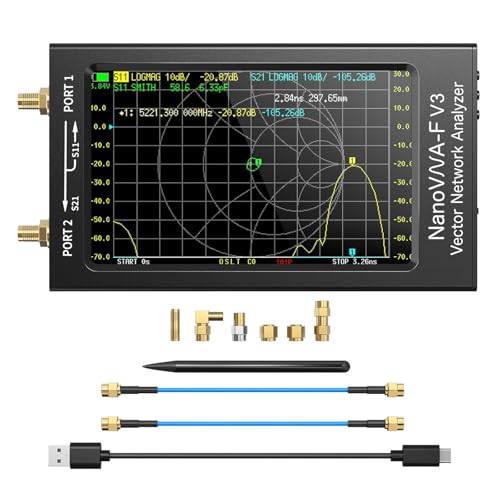
Sweep RF and antenna performance
NanoVNA-F V3
$299.99
See all sweep rf and antenna performance picks →Rigol DS1104Z-S Plus
Prices may change · Free shipping with Prime
◆ Design & Build Quality
The DS1104Z-S Plus is physically identical to the DS1054Z. It measures 313 x 161 x 122mm, weighs 3.2kg, and uses the same enclosure, front panel layout, and display. If you have seen a DS1054Z on a bench, you have seen the DS1104Z-S Plus. The only external difference is the additional BNC connector for the function generator output.
Build quality is the same well-regarded quality as the DS1054Z. The enclosure is solid without flex. The knobs are smooth with good detent feel. The buttons have positive click responses. The overall build conveys the impression of a serious instrument rather than a budget toy. The DS1000Z platform has been in production for nearly a decade, and Rigol has refined the manufacturing to a consistent standard.
The 7-inch TFT LCD is the same non-touch panel as the DS1054Z. Viewing straight on, it is adequate for bench work. Off-axis viewing is limited. The display resolution handles 4-channel display with measurement readouts, though it looks dated compared to the IPS panels on the DHO924S and Siglent SDS2104X Plus. There is no touchscreen — all interaction is through physical buttons and knobs.
The four BNC channel inputs and the function generator BNC output are on the front panel. The rear panel provides USB, LAN, and external trigger connections. USB host ports accept flash drives for waveform storage and screenshot saving.
The fan noise is identical to the DS1054Z: audible in a quiet room, invisible in a workshop. If you are buying the DS1104Z-S Plus for a quiet home office, consider that the fan runs continuously.
Included probes are Rigol's standard passive probes, which are good quality for stock accessories. The function generator output is a standard BNC, compatible with standard test leads and cables.
◆ Performance & Specifications Deep Dive
The DS1104Z-S Plus provides 100MHz bandwidth at 1GSa/s across 4 channels, with 12Mpt memory depth. The bandwidth is the specification that most directly differentiates it from the DS1054Z: 100MHz instead of 50MHz, officially unlocked without any hack.
100MHz bandwidth covers the vast majority of hobbyist and many professional use cases. SPI at clock rates up to 15-20MHz is comfortably within range. I2C at any standard speed is trivially within bandwidth. Arduino, ESP32, STM32, and Raspberry Pi Pico signals are all well-served. Basic RF verification for oscillators up to 50-70MHz is practical. Rise time measurements on signals with rise times down to about 3.5ns are meaningful.
Where 100MHz becomes limiting: high-speed SPI above 20MHz, USB signal analysis, fast Ethernet physical layer measurements, and RF work above about 80MHz. The Siglent SDS1202X-E provides 200MHz, and the Rigol DHO924S provides 250MHz. For these high-frequency applications, both alternatives offer significantly more headroom.
The 1GSa/s sample rate provides 10x oversampling at 100MHz bandwidth, which is the sweet spot for clean waveform display. You will see accurate representations of signals up to the bandwidth limit without visible sampling artifacts. This is a good relationship between sample rate and bandwidth.
The 12Mpt memory depth is the same as the DS1054Z and remains excellent at this price point. At 1GSa/s, you get 12 milliseconds of capture at full sample rate. For comparison, the DHO924S provides 50Mpt (4x more). The SDS1202X-E provides 14Mpt (slightly more). The 12Mpt is adequate for most analysis tasks but is the specification where the DHO924S's advantage is most apparent — the ability to capture 4x longer waveforms at full speed makes a tangible difference in post-capture analysis.
The trigger system is identical to the DS1054Z: 12 trigger types including Pattern, Runt, Setup/Hold, Nth Edge, and other advanced modes that rival scopes twice the price. This is one of the DS1000Z platform's enduring strengths. No other scope under $500 matches this trigger capability, and the DHO924S's trigger set (while also comprehensive) is the same.
The built-in 25MHz function generator outputs sine, square, ramp, pulse, noise, DC, and arbitrary waveforms. 25MHz is sufficient for most test signal needs — generating clock signals, injecting test patterns, and creating stimulus signals for analog circuit testing. The output amplitude range and waveform quality are adequate for hobbyist work. The function generator eliminates the need for a separate signal source, which is a genuine convenience that saves bench space and cost.
Protocol decoding includes SPI, I2C, UART, and RS232. As with the DS1054Z, CAN and LIN require paid licenses. The DHO924S includes CAN and LIN at no extra cost.
◆ Software & User Experience
The user experience is identical to the DS1054Z because the DS1104Z-S Plus runs the same firmware on the same hardware platform. The button-and-knob interface, menu structure, soft key navigation, and overall workflow are the same. If you have used a DS1054Z, you can operate the DS1104Z-S Plus with zero learning curve. If you have not, expect the same moderate learning period as the DS1054Z.
The function generator adds a dedicated menu accessible through a front panel button. The function generator settings include waveform type, frequency, amplitude, offset, and duty cycle (for square and pulse waveforms). The interface for the function generator is straightforward — select waveform type, set frequency with the knob, and enable output. There is no modulation capability or sweep function at the level of a dedicated function generator, but for generating test signals, the interface is efficient.
Automatic measurements, math functions, FFT, cursor measurements, waveform recording, and mask testing are all identical to the DS1054Z. The measurement system supports 37 measurement types with statistics. The FFT supports multiple window functions. These are well-documented features with extensive community tutorials available.
Rigol's UltraScope PC software provides remote control over USB or LAN, and SCPI command support enables scripted automation. The software ecosystem is the same as the DS1054Z's, which means the same extensive community documentation applies.
The community support advantage is inherited directly from the DS1054Z. Because the DS1104Z-S Plus uses the same platform, every tutorial, forum answer, and troubleshooting guide written for the DS1054Z applies directly to the DS1104Z-S Plus. The only differences are the bandwidth setting and the function generator menu. This institutional knowledge is a genuine practical advantage.
The interface feels dated compared to the DHO924S. The button-based navigation, non-touch display, and TFT panel are all characteristics of a platform designed years ago. The DHO924S's IPS touchscreen provides a more pleasant daily experience. Whether that experience difference is worth trading away the DS1000Z platform's proven reliability is a personal judgment.
◆ Protocol Decoding & Advanced Features
Protocol decoding on the DS1104Z-S Plus is identical to the DS1054Z. SPI, I2C, UART, and RS232 are included at no extra cost. CAN and LIN require paid licenses.
With 4 channels and 100MHz bandwidth, the DS1104Z-S Plus is a strong platform for protocol debugging. SPI decoding can use all 4 channels to monitor clock, MOSI, MISO, and chip-select simultaneously. This is the primary advantage of 4 channels for embedded development work and a capability that 2-channel scopes like the SDS1202X-E cannot match.
I2C decoding uses 2 channels for SDA and SCL, leaving 2 channels free for monitoring related signals like interrupt lines, enable pins, or power rails. The ability to correlate protocol data with physical signals is one of the most valuable aspects of having 4 channels with protocol decoding.
The 100MHz bandwidth (versus the DS1054Z's 50MHz stock) provides better visibility of fast protocol edges. SPI clock signals at 8-10MHz display with cleaner edges and more accurate timing measurements. I2C fast-mode plus (1MHz) signals are well within the bandwidth capability.
The trigger system offers the same 12 types as the DS1054Z. Pattern triggering across 4 channels is particularly powerful for protocol debugging: you can trigger when specific combinations of signal levels occur simultaneously, such as when chip-select goes low while a specific data pattern is present on the bus.
The built-in 25MHz function generator adds capability that the DS1054Z lacks. For testing, you can generate a clock signal on the function generator output and feed it to a circuit while monitoring the circuit's response on the oscilloscope channels. This internal stimulus-and-measure capability is valuable for characterization work and eliminates the need for external signal sources.
Waveform recording and mask testing are available, identical to the DS1054Z implementation. The scope supports USB flash drive storage for screenshots, waveform data, and settings backup.
The absence of CAN and LIN decoding without paid licenses is a limitation that the DHO924S (around $899) and SDS1104X-U ($419) address by including these protocols free. If automotive protocol support is important, the DS1104Z-S Plus is not the most cost-effective choice.
◆ Real-World Use Cases
For embedded development, the DS1104Z-S Plus is an excellent tool. The combination of 100MHz bandwidth, 4 channels, protocol decoding, and a function generator provides a complete debugging and testing platform. You can generate test signals, monitor multiple bus lines simultaneously, decode protocol data, and use advanced triggers to isolate specific events. This is the scope's strongest use case and the primary reason to consider it.
For teaching labs and education, the DS1104Z-S Plus has unique advantages. The integrated function generator eliminates the need for separate signal generators at each lab station, reducing equipment costs and bench space requirements. The proven DS1000Z platform means instructors can use existing course materials and tutorials. The 100MHz bandwidth and 4 channels provide enough capability for undergraduate and hobbyist-level coursework.
For Arduino and microcontroller projects, the scope provides more capability than most projects require. The 100MHz bandwidth is overkill for Arduino's 16MHz clock, but the 4 channels are valuable when debugging multi-signal projects. The function generator can serve as a signal source for testing sensor interfaces and communication buses.
For power supply design, the 100MHz bandwidth provides adequate visibility of switching frequencies and harmonics for most hobbyist-level supplies. The 4 channels allow simultaneous monitoring of input, output, switching node, and feedback loop. The function generator can inject test signals for characterizing load transient response.
For audio electronics, the scope is more than sufficient. Audio frequencies are trivially within bandwidth, and the function generator provides a convenient audio signal source for testing. The FFT provides basic spectrum analysis.
For RF work, 100MHz bandwidth is limiting. The DHO924S around $899 provides 250MHz, and the SDS1202X-E at $379 provides 200MHz. If RF analysis is a primary use case, the DS1104Z-S Plus's bandwidth is a constraint.
For automotive electronics, the lack of free CAN/LIN decoding is a disadvantage. The DHO924S (around $899) and SDS1104X-U ($419) include CAN and LIN at no extra cost. Purchasing CAN decoding licenses for the DS1104Z-S Plus adds to the already-higher purchase price.
◆ Who Should Buy This (And Who Shouldn't)
Buy the Rigol DS1104Z-S Plus if you specifically need the proven DS1000Z platform with full 100MHz bandwidth and an integrated function generator. Teaching labs that have standardized on the DS1000Z platform and need the function generator to eliminate separate signal generators are the clearest use case. The platform's reliability, extensive documentation, and educational material integration are real advantages in institutional settings.
Buy it if you specifically value the DS1000Z platform's proven long-term reliability over the DHO924S's newer, less-proven platform. The DS1000Z has nearly a decade of demonstrated reliability. The DHO924S, while excellent, has a shorter track record. If minimizing risk matters more than maximizing specifications, the DS1104Z-S Plus is the conservative choice.
Do not buy the DS1104Z-S Plus if you are a hobbyist buying a scope for personal use and your budget reaches the DHO924S tier. For more money, the DHO924S provides 250MHz bandwidth (2.5x more), 50Mpt memory (4x more), an IPS touchscreen, WiFi, a function generator, and CAN/LIN decoding. The specification advantage is overwhelming, and the DHO924S's platform has matured sufficiently through firmware updates to be reliable for daily use.
Do not buy it if CAN or LIN protocol decoding is important without paying license fees. The DHO924S and SDS1104X-U both include CAN/LIN decoding at no extra cost. On the DS1104Z-S Plus, these protocols require paid licenses that increase the total ownership cost.
Do not buy it if you want a modern user interface experience. The TFT non-touch display and button-based navigation are functional but feel dated. The DHO924S's IPS touchscreen provides a meaningfully better daily experience for scope interaction.
Do not buy it if you prioritize bandwidth for RF or high-speed digital work. At 100MHz, the DS1104Z-S Plus is outclassed by the DHO924S (250MHz) and SDS1202X-E (200MHz) at lower or higher prices depending on the model.
◆ Alternatives Worth Considering
The Rigol DHO924S around $899 is the most important alternative and the scope that challenges the DS1104Z-S Plus's value proposition most directly. For roughly $200 more, the DHO924S provides 250MHz bandwidth, 4 channels, 50Mpt memory, a 7-inch IPS touchscreen, WiFi, a built-in function generator, and CAN/LIN decoding. In every measurable specification, the DHO924S is superior. The DS1104Z-S Plus's advantages over the DHO924S are limited to platform maturity and community documentation depth — both real but increasingly narrow as the DHO924S builds its own user base.
The Rigol DS1054Z at $349 is the budget version of the same platform. It costs $350 less and provides the same 4 channels, 12Mpt memory, protocol decoding, and trigger set, with the trade-offs being 50MHz stock bandwidth (hackable to 100MHz) and no function generator. If you are comfortable with the bandwidth hack and already own a function generator, the DS1054Z provides most of the DS1104Z-S Plus's practical scope capability for about half the price.
The Siglent SDS1104X-U at $419 provides 100MHz, 4 channels, 14Mpt memory, and free CAN/LIN decoding. At roughly $280 less than the DS1104Z-S Plus, it matches the bandwidth and channel count while adding automotive protocol support without license fees. It lacks a function generator, but the price savings could fund a standalone function generator.
The Siglent SDS1202X-E at $379 takes the opposite trade-off: 200MHz bandwidth with 2 channels. For work that prioritizes bandwidth over channel count, it costs roughly $320 less than the DS1104Z-S Plus while providing double the bandwidth. Free CAN/LIN decoding is included.
The Siglent SDS2104X Plus around $1,400 is the premium alternative for those who want the best possible bench instrument. At about double the price, it provides 200Mpt memory, a 10.1-inch IPS touchscreen, 2GSa/s sample rate, comprehensive protocol decoding including FlexRay and I2S, and a function generator. If budget allows, it is a meaningfully better instrument for serious work.
Our Verdict
The DS1104Z-S Plus is the DS1054Z with the limitations officially removed: full 100MHz bandwidth and a built-in 25MHz function generator. At ~$699, it's the premium version of a proven platform that has a decade of community support behind it. The problem in 2026 is that newer touchscreen scopes have made the DS1000Z platform feel dated. The DHO924S costs more now, but it brings 250MHz bandwidth, a 7-inch IPS touchscreen, WiFi, 50Mpt memory, and a much more modern workflow. I'd only choose the DS1104Z-S Plus if you're buying for a teaching lab with specific software integration requirements, or if you specifically need the proven DS1000Z platform.
Rigol DS1104Z-S Plus
$699
Prices may change · Free shipping with Prime
◆ Full Specifications
| Full Specifications | |
|---|---|
| Bandwidth | 100MHz |
| Sample Rate | 1GSa/s |
| Channels | 4 |
| Memory Depth | 12 Mpts |
| Display Size | 7" |
| Display Type | TFT LCD |
| Form Factor | Benchtop |
| Weight | 3.2kg |
| Dimensions | 313 x 161 x 122 mm |
| Protocol Decoder | SPI, I2C, UART, RS232 |
| Function Generator | Yes |
| WiFi | No |
| Battery Option | No |
| Trigger Types | Edge, Pulse, Slope, Video, Pattern, Duration, Timeout, Runt, Window, Delay, Setup/Hold, Nth Edge |
◆ Frequently Asked Questions
Why would I buy the DS1104Z-S Plus instead of the DHO924S?
Is the DS1104Z-S Plus worth about $350 more than the DS1054Z?
Does the function generator affect oscilloscope performance?
Can I add CAN/LIN decoding to the DS1104Z-S Plus?
Is the DS1104Z-S Plus being discontinued?
How does the 25MHz function generator compare to standalone generators?
Is the DS1000Z platform still getting firmware updates?
Should I buy this for a teaching lab?
◆ Related Buying Guides
Compare With Similar Scopes
◆ Head-to-Head Comparisons
Rigol DS1104Z-S Plus
$699
Prices may change · Free shipping with Prime