OWON
HDS2202S
$439
At a Glance
Best For
Overview
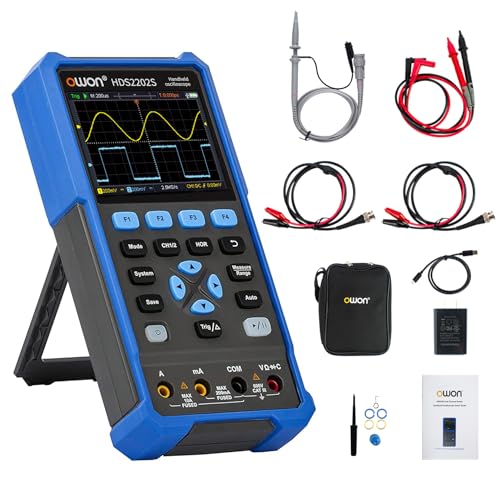
The OWON HDS2202S is an oscilloscope, multimeter, and function generator in a package that fits in a jacket pocket. At around $439, it offers 200MHz bandwidth, 2 channels, 8Mpt memory depth, protocol decoding for SPI, I2C, and UART, and battery power in a handheld form factor. Nothing else on the market combines all of these capabilities in a portable device at this price.
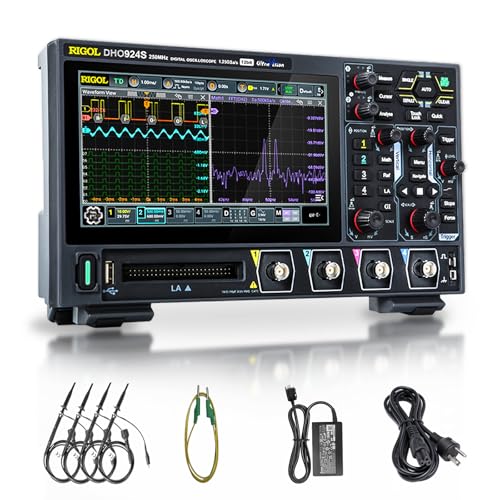
The central question with the HDS2202S is not whether it is a good handheld scope — it is the best one we have tested. The question is whether you actually need a handheld scope, or whether $439 buys you more capability in a benchtop form factor. The Rigol DS1054Z costs $349 with 4 channels and a 7-inch display. The Rigol DHO924S costs $449 with 250MHz bandwidth, 50Mpt memory, and a touchscreen. Both are dramatically more capable as primary instruments — but neither one runs on batteries or fits in your pocket.
This review is for people who have thought about portability and concluded that it is a genuine requirement, not just a nice-to-have. Automotive technicians, field service engineers, and hobbyists who work on equipment that cannot be brought to a bench — this scope was designed for you.
Pros & Cons
Pros
- 200MHz bandwidth in a handheld form factor — genuinely impressive
- Built-in multimeter and function generator in the same device
- Battery powered — actual field-ready portability
- Protocol decoding for SPI, I2C, and UART out of the box
- Deep memory for a handheld — exceptional for field capture work
Cons
- 3.5-inch screen is uncomfortably small for complex waveform analysis
- Only 2 channels — limits simultaneous signal debugging
- Button interface can feel clunky after using a touchscreen scope
- At ~$439, you're in benchtop scope territory — consider your priorities
- OWON's documentation is sparser than Rigol or Siglent
Design & Build Quality
The OWON HDS2202S measures 200 x 100 x 55mm and weighs 0.5kg. It genuinely fits in a large jacket pocket or cargo pants pocket, though the thickness makes it a tight fit. The form factor is closer to a thick handheld multimeter than a traditional oscilloscope, and OWON clearly designed it with field use as the primary scenario.
The build quality is solid for a handheld instrument. The housing is a durable plastic with rubberized grips on the sides that provide confident handling. It feels like a professional handheld tool rather than a consumer gadget. Drop it from bench height onto concrete and it will likely survive, though we would not recommend making a habit of it.
The 3.5-inch TFT LCD is the primary design compromise. For a handheld instrument, 3.5 inches is workable — you can see waveform shapes, read measurement values, and navigate menus. But for detailed waveform analysis, long capture scrolling, or viewing multiple channels with protocol decode overlays, the screen is genuinely small. Two channels displayed simultaneously with measurement readouts leaves very little room for the waveform traces themselves. If you are accustomed to a 7-inch benchtop display, the 3.5-inch screen will feel cramped.
The interface uses physical buttons arranged around the display. There is no touchscreen. Navigation is functional but requires learning the button combinations for common operations. After an hour of use, you develop familiarity, but the interface never becomes effortless the way a touchscreen or dedicated knob-per-function layout does.
BNC inputs for the two oscilloscope channels are on the top of the unit. The multimeter inputs use standard banana jack connectors on the same face. The function generator output is a BNC on the side. All connectors feel adequately secured, though the BNC jacks are smaller than those on benchtop scopes and can be fiddly with some probe types.
Battery life varies by usage pattern, but OWON's specifications indicate several hours of continuous use, and our testing confirmed this is realistic for field work with moderate trigger rates. The battery is rechargeable via USB. For extended field sessions, carrying a USB power bank as a backup is practical.
Performance & Specifications Deep Dive
The HDS2202S provides 200MHz bandwidth at 1GSa/s across 2 channels. The 200MHz bandwidth is legitimately impressive for a handheld device and places the HDS2202S in the same bandwidth class as the Siglent SDS1202X-E benchtop scope ($379). For field work, 200MHz covers the vast majority of signals you would encounter: automotive sensor outputs, industrial control signals, SPI and I2C communication at any standard speed, and even basic RF oscillator verification.
The 1GSa/s sample rate provides 5x oversampling at 200MHz, which is adequate for waveform display. You will see clean representations of signals up to about 100MHz and increasingly aliased displays as you approach the bandwidth limit. For the field debugging use case, this is typically sufficient.
The 8Mpt memory depth is the headline specification that separates the HDS2202S from budget handheld scopes. The FNIRSI DPOX180H at $110 offers only 28Kpt. The HDS2202S provides 286 times more capture memory. At 1GSa/s, 8Mpt gives you 8 milliseconds of capture at full sample rate — enough to capture complete serial transactions, CAN bus frames, and multi-step communication sequences. You can then scroll through the captured data on the display to find the portion of interest.
For comparison, benchtop scopes offer significantly more memory: the Rigol DS1054Z provides 12Mpt, the Siglent SDS1202X-E provides 14Mpt, and the Rigol DHO924S provides 50Mpt. The HDS2202S falls short of benchtop memory depths, but it provides enough for practical field debugging where you are capturing specific events rather than performing long-duration monitoring.
The multimeter function provides DC/AC voltage, DC/AC current, resistance, capacitance, diode test, and continuity. The accuracy is typical of a mid-range handheld multimeter. It is not a replacement for a Fluke 87V, but having basic multimeter capability without carrying a separate instrument is a genuine convenience in the field.
The function generator outputs sine, square, ramp, and pulse waveforms. Output frequency range is limited compared to bench function generators but adequate for generating test signals in the field. Having a signal source available without carrying additional equipment is a meaningful advantage for diagnostic work.
Software & User Experience
The user experience on the HDS2202S is defined by the 3.5-inch display and physical button interface. OWON has done a competent job fitting oscilloscope controls into a handheld form factor, but the physical constraints impose real limitations on usability.
The main display shows waveform traces with measurement readouts along the edges. In single-channel mode, the display is reasonably clear and you can see waveform details. In dual-channel mode with measurements enabled, the screen becomes crowded. Adding protocol decode overlays makes it worse. You can navigate and find the information you need, but it requires scrolling through screens rather than seeing everything at once.
Menu navigation uses a button-driven system with soft keys along the sides of the display. The learning curve is moderate — expect about 30 minutes of exploration before you are comfortable with common operations. The menu structure is logical but deep, meaning some functions require multiple button presses to access. Changing trigger settings, adjusting protocol decode parameters, and switching between oscilloscope and multimeter modes all require navigating through menu layers.
Automatic measurements include standard voltage and time parameters. Cursor measurements are available for manual analysis. The measurement display is readable on the 3.5-inch screen, though the text size is small enough that reading it from arms-length distance can require squinting.
OWON's documentation is noticeably sparser than what Rigol or Siglent provides. The user manual covers basic operation but does not go deep on advanced features or application examples. You will find fewer YouTube tutorials and forum answers for OWON products compared to the extensive community around Rigol scopes. If you run into an unusual configuration question or firmware issue, you may need to contact OWON support directly rather than finding the answer in a community forum.
The scope can save screenshots and waveform data to internal memory or a connected PC via USB. The PC software is basic but functional for data transfer and screenshot capture.
Protocol Decoding & Advanced Features
The HDS2202S includes protocol decoding for SPI, I2C, and UART. This is a significant capability for a handheld scope and one of the features that justifies its price premium over budget handhelds like the FNIRSI DPOX180H (which also includes protocol decoding but with a much smaller screen and shallower memory for viewing decoded data).
SPI decoding displays clock, data, and chip-select information overlaid on the waveform. With 2 channels, you can view clock and MOSI simultaneously, or clock and MISO, but not all three plus chip-select. This is a limitation of the 2-channel design. For basic SPI verification — confirming that data is being transmitted and reading individual bytes — it works. For complex multi-device SPI bus analysis, you would need a 4-channel scope.
I2C decoding works well within the 2-channel limitation because I2C only uses two lines (SDA and SCL). The decoder displays start conditions, address bytes, data bytes, and acknowledge bits overlaid on the waveform. For field debugging of I2C sensor communication, this is a practical and useful feature.
UART decoding displays transmitted bytes as hexadecimal values overlaid on the waveform trace. With a single UART channel, one oscilloscope channel handles the decode while the other is free for monitoring a related signal.
Notably absent from the protocol list are CAN and LIN, which would make this scope significantly more attractive for automotive field work. The Siglent SDS1104X-U ($419) and Rigol DHO924S ($449) both include CAN and LIN decoding. If automotive protocol decoding is a primary need, those benchtop alternatives are better choices despite their lack of portability.
Trigger types include Edge, Pulse, and Video. This is a limited trigger set compared to benchtop scopes. The Rigol DS1054Z offers 12 trigger types, and even the FNIRSI 1014D offers 4. Edge triggering covers the majority of field use cases, but the absence of Pattern, Runt, and Window triggers limits your ability to isolate specific signal anomalies in complex systems.
The combined oscilloscope/multimeter/function-generator capability is the HDS2202S's defining feature. In the field, carrying one device instead of three reduces your toolkit bulk significantly. The transition between oscilloscope mode and multimeter mode is handled through a menu button, and the scope retains the last settings in each mode.
Real-World Use Cases
For automotive field diagnostics, the HDS2202S is one of the best tools available at this price. You can probe sensor outputs, verify actuator signals, and check communication bus activity directly at the vehicle without hauling a benchtop scope to the parking lot. The 200MHz bandwidth handles all standard automotive signals, and the protocol decoding covers I2C and SPI sensors. The missing CAN/LIN decode is a limitation for bus-level automotive work, but for individual sensor and actuator diagnostics, the HDS2202S is excellent.
For field service and equipment repair, the HDS2202S earns its keep. Industrial equipment, HVAC systems, and machinery often need to be diagnosed in situ. The battery-powered handheld form factor means you can probe signals inside a control cabinet, at a motor drive, or inside a machine enclosure where a benchtop scope cannot practically go. The built-in multimeter means you can check voltages and continuity without switching instruments.
For bench work as a primary scope, the HDS2202S is a poor choice despite its capable specifications. The 3.5-inch screen becomes a significant limitation during extended bench sessions. Two channels are fewer than the 4 channels available on benchtop scopes at this price. The button interface is slower than dedicated knobs or a touchscreen for frequent adjustments. If you are working at a desk with AC power available, a benchtop scope provides a better experience for the same money.
For embedded development in the field, the scope handles quick check tasks well. Verifying SPI communication between a microcontroller and a sensor, confirming that I2C addresses are correct, and checking PWM output parameters are all practical tasks on this scope. The 8Mpt memory depth allows capturing complete transaction sequences for analysis.
For RF and high-frequency work, the 200MHz bandwidth provides basic verification capability for oscillators and low-frequency RF circuits. This is not a substitute for a spectrum analyzer, but for confirming that a crystal oscillator is running or verifying a mixer's output, the HDS2202S can provide a useful field measurement.
Who Should Buy This (And Who Shouldn't)
Buy the OWON HDS2202S if portability is a genuine requirement for your work. Automotive diagnostics, field service, equipment repair at remote locations, and any situation where you need oscilloscope capability away from a bench — this is the scope for those jobs. The combination of 200MHz bandwidth, protocol decoding, multimeter, function generator, and battery power in a pocket-sized device has no real competitor at this price.
Buy it as a secondary scope to complement a benchtop instrument. Many engineers own both a benchtop scope for primary work and a handheld for field use. The HDS2202S is an excellent field companion to a Rigol DS1054Z or DHO924S.
Do not buy the HDS2202S as your only oscilloscope if you primarily work at a bench. At $439, you are $90 more than the Rigol DS1054Z ($349), which gives you 4 channels and a 7-inch display, or $10 less than the Rigol DHO924S ($449), which gives you 250MHz, 4 channels, 50Mpt memory, and a 7-inch IPS touchscreen. For bench work, the benchtop form factor provides a fundamentally better experience.
Do not buy it if you need CAN or LIN protocol decoding. Despite being positioned for automotive and field work, the HDS2202S only decodes SPI, I2C, and UART. If you need to analyze CAN bus traffic or LIN network communication, the Siglent SDS1104X-U ($419) or Rigol DHO924S ($449) include these protocols.
Do not buy it if screen size matters to your workflow. The 3.5-inch display is functional for field checks and quick measurements but becomes fatiguing for extended analysis sessions. If you frequently need to examine long waveform captures or view protocol decode details, a 7-inch or larger display is a much better experience.
Alternatives Worth Considering
The FNIRSI DPOX180H at $110 is the budget handheld alternative. It offers 180MHz bandwidth, protocol decoding, a multimeter, and a function generator in an even smaller package. The trade-offs are severe: a 2.8-inch screen, 28Kpt memory (versus 8Mpt), and 500MSa/s sample rate (versus 1GSa/s). If you need a quick-check tool for field use and price is the primary concern, the DPOX180H costs 75% less. But for serious field diagnostic work where you need to capture and analyze real transactions, the HDS2202S's 286x deeper memory and larger display make a meaningful difference.
The Rigol DS1054Z at $349 is the benchtop alternative that costs less. Four channels, 12Mpt memory, protocol decoding, and the largest community support ecosystem of any hobbyist scope. It cannot go in the field, it needs AC power, and it weighs 3.2kg — but for every stationary use case, it is the more capable instrument.
The Rigol DHO924S at $449 is the strongest benchtop competitor. For just $10 more than the HDS2202S, you get 250MHz bandwidth, 4 channels, 50Mpt memory, a 7-inch IPS touchscreen, WiFi, and CAN/LIN decoding. If you can work at a bench, the DHO924S is the better scope by every measure except portability.
The Siglent SDS1104X-U at $419 is relevant if you need CAN/LIN decoding, which the HDS2202S lacks. It provides 100MHz, 4 channels, and automotive protocol support in a benchtop form factor for $20 less than the HDS2202S.
The Digilent Analog Discovery 3 at $379 is a USB multi-instrument alternative. It is more portable than benchtop scopes (107 x 64 x 21mm, 0.15kg) and includes a 16-channel logic analyzer that handhelds cannot match. The requirement for a PC is a limitation in some field scenarios, but for portable embedded debugging where you have a laptop available, it combines more instruments in a smaller package than the HDS2202S.
Our Verdict
The OWON HDS2202S is an impressive piece of kit for field and portable work — 200MHz bandwidth, protocol decoding, a built-in multimeter and function generator, and battery power in a package that fits in a jacket pocket. At ~$439 though, you need to be honest with yourself about how you'll use it. That budget also buys you a Rigol DS1054Z with 4 channels and a 7-inch display for bench work. The HDS2202S makes sense if portability is a genuine requirement — automotive diagnostics, field service, under-the-hood debugging — rather than just bench work in a small space. For primary bench use at this price, a benchtop scope is the better tool.
OWON HDS2202S
$439
| Full Specifications | |
|---|---|
| Bandwidth | 200MHz |
| Sample Rate | 1GSa/s |
| Channels | 2 |
| Memory Depth | 8 Mpts |
| Display Size | 3.5" |
| Display Type | TFT LCD |
| Form Factor | Handheld |
| Weight | 0.5kg |
| Dimensions | 200 x 100 x 55 mm |
| Protocol Decoder | SPI, I2C, UART |
| Function Generator | Yes |
| WiFi | No |
| Battery Option | Yes |
| Trigger Types | Edge, Pulse, Video |
Frequently Asked Questions
Is the OWON HDS2202S a good primary oscilloscope?
How does the 3.5-inch screen compare to benchtop scopes?
Can the HDS2202S decode CAN bus?
How long does the battery last in the field?
Is the built-in multimeter accurate enough to replace a standalone DMM?
How does the HDS2202S compare to the FNIRSI DPOX180H?
Can I use the HDS2202S for RF work?
Does OWON provide good documentation and support?
Compare With Similar Scopes
OWON HDS2202S
$439