◆ At a Glance
◆ Best For
◆ Overview
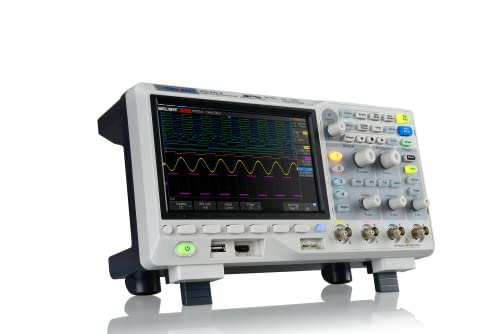
The Siglent SDS1204X-E is a scope that was an excellent value two years ago and has since been lapped by the competition. At $775, it delivers 200 MHz bandwidth, 4 channels, 14 Mpt memory depth, and free CAN/LIN protocol decoding on a proven, reliable platform. Those specifications are genuinely good. The problem is that in 2026, you can get most of those capabilities -- and more -- for significantly less money.
This is the 4-channel, 200 MHz version of the SDS1202X-E that we also review. Where the SDS1202X-E at $379 trades channel count for bandwidth (200 MHz with 2 channels), the SDS1204X-E gives you the full 4 channels at the same 200 MHz bandwidth. The CAN and LIN decoding is included without license fees, the 14 Mpt memory depth handles long captures, and Siglent's firmware has been refined through years of updates.
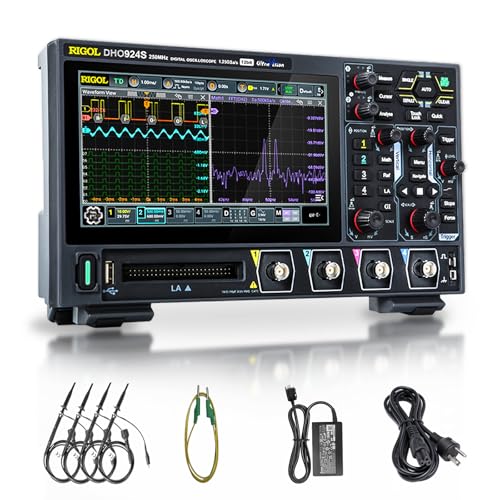
The challenge is the Rigol DHO924S around $899, which offers 250 MHz bandwidth, a 7-inch IPS touchscreen, 50 Mpt memory depth, a built-in function generator, WiFi, and CAN/LIN decoding -- all at a higher current price. The SDS1204X-E isn't a bad scope by any measure. It's a good scope at a price that no longer makes sense given what else is available.
◆ Pros & Cons
Pros
- 200MHz bandwidth with 4 channels — strong spec combination
- CAN and LIN decoding included at no extra cost
- 14Mpt memory depth for long serial transaction captures
- Proven, reliable platform with a solid firmware update history
- Good long-term track record from Siglent
Cons
- At ~$775, it sits close enough to premium touchscreen scopes that the use case needs to be clear
- 7-inch non-touch display feels dated compared to modern alternatives
- No function generator
- Hard to justify the $356 premium over the SDS1104X-U at $419
You'll Also Need
Common accessories that pair well with this scope.
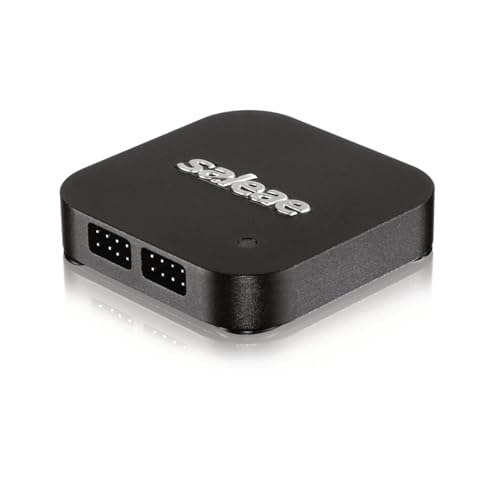
Hantek PP-200 200MHz Probe Set (2x)
Replacement 200MHz passive probes compatible with most bench scopes
Buy on Amazon · $18 →DEVMO USB Logic Analyzer 8-Channel
8-channel logic analyzer for debugging digital signals and protocols
Buy on Amazon · $14 →Coaxial BNC Cable 50Ω (3-pack)
BNC to BNC 50Ω coax cables for signal connections
Buy on Amazon · $12 →◆ More Bench Gear We've Reviewed
Beyond the scope: other instruments hobbyists keep on the bench.
See signals in the frequency domain
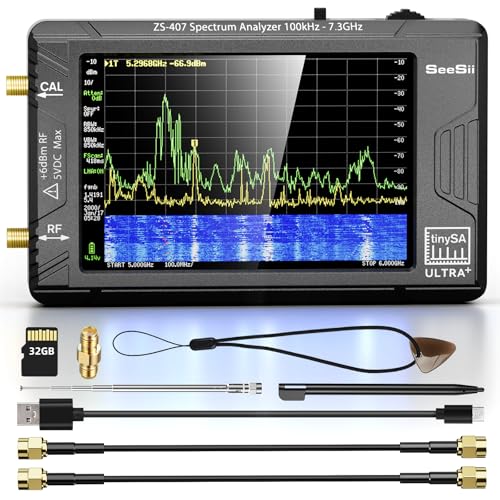
TinySA Ultra
$260.9
See all see signals in the frequency domain picks →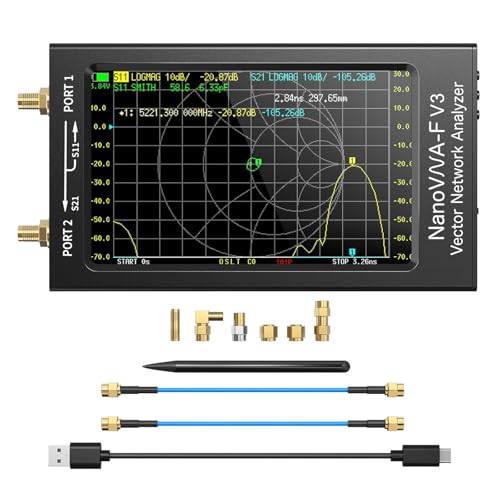
Sweep RF and antenna performance
NanoVNA-F V3
$299.99
See all sweep rf and antenna performance picks →Siglent SDS1204X-E
Prices may change · Free shipping with Prime
◆ Design & Build Quality
The SDS1204X-E shares the same 312 x 151 x 127 mm chassis as the SDS1202X-E, weighing 3.3 kg. It's a compact benchtop form factor that fits comfortably on smaller workbenches. Build quality is consistent with Siglent's standards -- solid construction, secure BNC connectors, knobs with good tactile feedback, and a chassis that feels built to last. Siglent's hardware reliability has been one of the brand's consistent strengths, and the SDS1204X-E benefits from years of manufacturing refinement.
The 7-inch TFT LCD display is functional but feels dated in 2026. Colors are adequate for waveform identification, the resolution is sufficient for measurement readouts, and viewing angles are acceptable at typical bench positions. But compared to the IPS touchscreens on the Rigol DHO series or the Siglent SDS2104X Plus, the non-touch TFT feels like previous-generation technology. All interaction happens through physical buttons and rotary encoders.
The button-and-knob interface is well-executed for what it is. Siglent has refined the control layout over multiple product generations, and experienced users can navigate quickly through the menu system. Dedicated buttons for common functions reduce the menu-diving required for everyday operations. The learning curve is moderate -- expect a few hours of familiarization before the layout becomes second nature.
The included probes are standard Siglent offerings, appropriate for 200 MHz work. They're better than the probes shipped with budget alternatives but not as refined as what ships with the SDS2104X Plus. For most hobbyist work, they're perfectly adequate. Probe compensation is straightforward using the built-in calibration signal output.
◆ Performance & Specifications Deep Dive
The 200 MHz bandwidth is the SDS1204X-E's strongest specification and the primary reason to consider it. At 200 MHz, you can accurately measure signals up to approximately 65-80 MHz with full amplitude accuracy, and the scope provides useful visibility on faster signals with increasing attenuation up to the -3 dB point. For SPI at clock speeds up to 50 MHz, USB full speed, fast UART, and most embedded digital interfaces, 200 MHz is comfortable.
Having 200 MHz across 4 channels is genuinely valuable. The SDS1202X-E offers the same bandwidth but only 2 channels, which limits its usefulness for multi-signal debugging. With 4 channels, you can simultaneously monitor SPI (clock, MOSI, MISO, chip select), or I2C (SDA, SCL) plus two reference signals, or CAN-H and CAN-L plus power and a trigger signal. For protocol work, 4 channels eliminates the constant probe-swapping that makes 2-channel scopes tedious.
The 1 GSa/s sample rate provides 5x oversampling at the rated bandwidth, which is adequate for clean waveform reconstruction and accurate measurements. The Rigol DHO924S's 1.25 GSa/s offers a slight advantage, and the Siglent SDS2104X Plus's 2 GSa/s provides notably better oversampling at lower bandwidth.
The 14 Mpt memory depth matches the SDS1104X-U and exceeds the DS1054Z's 12 Mpts. At 1 GSa/s, 14 million points gives you 14 milliseconds of continuous full-rate capture. This is acceptable for individual protocol transactions but feels limiting for extended monitoring. The DHO924S's 50 Mpts (3.6x more) and the SDS2104X Plus's 200 Mpts (14x more) provide substantially longer capture windows.
The trigger system includes edge, pulse, slope, video, window, interval, dropout, runt, and pattern triggers. It's a solid set that covers most debugging needs, though it lacks the duration, timeout, delay, setup/hold, and Nth edge triggers available on the Rigol DHO platform. For most hobbyist work, the available triggers are sufficient.
◆ Software & User Experience
Siglent's firmware on the SDS1204X-E is mature and reliable. The menu system is logically organized, response times are good, and the scope behaves predictably during extended use. Firmware updates have been consistent over the platform's lifetime, with Siglent adding features and fixing issues on a regular cadence. This is a genuine advantage of a proven platform -- you're buying a scope with known behavior and a track record.
The measurement system provides comprehensive automatic measurements: frequency, period, amplitude, peak-to-peak, RMS, mean, rise time, fall time, positive/negative duty cycle, positive/negative width, delay, and more. Math functions include add, subtract, multiply, divide, and FFT. The FFT implementation is one of Siglent's strengths, with configurable window functions and a clean frequency-domain display.
SPL (Siglent Programming Language) support enables on-instrument scripting for automated measurement sequences. This is a differentiating feature that cheaper scopes don't offer, and it's valuable for users who need repeatable test procedures or automated data collection.
PC connectivity is solid. SCPI over USB provides remote control capability compatible with Python (pyvisa), LabVIEW, MATLAB, and other automation platforms. Siglent's EasyScope software offers a GUI for remote viewing, control, and data export. The SCPI implementation is well-documented and consistent with Siglent's other products.
The absence of WiFi is notable compared to the DHO924S and even the DHO804, both of which include WiFi connectivity. For remote monitoring and wireless data export, you'll need USB or rely on PC-based connectivity.
◆ Protocol Decoding & Advanced Features
Protocol decoding covers SPI, I2C, UART, CAN, and LIN -- all included without additional license fees. This is the same protocol set as the DHO924S and the SDS1104X-U, and it covers the standard suite of embedded development protocols plus automotive buses.
The free CAN and LIN decoding has historically been one of Siglent's key differentiators. When Rigol charged extra for CAN options on the DS1054Z and DS1104Z-S, Siglent's included CAN/LIN support was a significant cost advantage. Now that Rigol includes CAN/LIN on the DHO924S, this advantage has diminished, though the Siglent implementation is well-tested and reliable.
CAN decoding handles standard and extended frame formats at all common baud rates. The display shows message IDs, data bytes, DLC, CRC status, and error flags. LIN decoding covers standard frame formats with header, response, and checksum fields. Both decoders are reliable and have been refined through years of firmware updates.
SPI decoding at 200 MHz bandwidth handles faster clock speeds than lower-bandwidth competitors, which is one of the SDS1204X-E's genuine advantages. If you're working with SPI flash at 50 MHz or SPI displays at high clock speeds, the 200 MHz bandwidth ensures accurate waveform capture alongside protocol decoding.
The 4-channel decoding capability lets you run multiple protocol decoders simultaneously across different channels. You can decode I2C on channels 1-2 while decoding UART on channel 3 and monitoring a reference signal on channel 4. This multi-decoder capability is identical to other 4-channel scopes in our lineup.
The trigger system supports triggering on decoded protocol conditions, letting you capture specific bus events. The interval and dropout triggers are particularly useful for catching timing anomalies on serial buses -- interval triggers catch unexpected timing gaps, and dropout triggers catch missing signals.
◆ Real-World Use Cases
The SDS1204X-E performs well in embedded development where you need 4 channels, 200 MHz bandwidth, and protocol decoding simultaneously. Debugging high-speed SPI communication, monitoring multi-bus embedded systems, and analyzing signal integrity on digital interfaces are all tasks where the scope's specifications align well with requirements.
Automotive embedded development benefits from the included CAN and LIN decoding. If you're building CAN-connected devices, debugging vehicle electronics, or developing automotive accessories, the free protocol support eliminates the need for paid decoder licenses. The 200 MHz bandwidth also provides headroom for CAN-FD at higher data rates.
Audio electronics work is well-served by the 200 MHz bandwidth (far more than audio requires), 4 channels (monitor multiple stages simultaneously), and accurate measurement system. Measuring frequency response, characterizing amplifiers, and analyzing filter behavior are all straightforward tasks on this scope.
RF work at lower frequencies -- HF amateur radio, crystal oscillator characterization, basic filter analysis -- is practical with 200 MHz bandwidth. For VHF and above, you'll need more bandwidth.
The challenge is that all of these use cases are also well-served by cheaper alternatives. The DHO924S handles embedded development and automotive work with 250 MHz bandwidth and a touchscreen at a higher current price. The SDS1104X-U handles CAN/LIN work with 100 MHz bandwidth for $356 less. The SDS1204X-E's unique position -- 200 MHz, 4 channels, CAN/LIN -- is a narrow niche that's hard to justify at the $775 price point.
◆ Who Should Buy This (And Who Shouldn't)
Buy the Siglent SDS1204X-E if you find it at a significant discount from the $775 list price. At $550-600, the value proposition improves substantially, and the 200 MHz bandwidth with 4 channels and free CAN/LIN decoding becomes a competitive offering. Watch for sales, open-box deals, and refurbished units.
Buy it if you specifically need Siglent's proven platform reliability and refuse to adopt a newer product line. The SDS1204X-E has years of firmware refinement, a known track record, and predictable behavior. If you're in a professional or educational environment where stability and track record matter more than specs-per-dollar, the SDS1204X-E's maturity is a legitimate advantage.
Buy it if you need 200 MHz bandwidth, 4 channels, and CAN/LIN decoding in a single instrument and can't use the alternatives for some reason. This exact combination of requirements is the SDS1204X-E's narrow sweet spot.
Do not buy it at list price ($775) for general hobbyist use. The Rigol DHO924S around $899 offers 250 MHz bandwidth, a touchscreen, 50 Mpt memory, a function generator, WiFi, and CAN/LIN decoding at a higher current price. You'd need a very specific justification to spend the extra money.
Do not buy it if you're comparing it to the Siglent SDS1104X-U at $419. The SDS1104X-U offers 4 channels with CAN/LIN decoding at $356 less. The SDS1204X-E's advantage is 200 MHz vs 100 MHz bandwidth -- you need to decide if that extra 100 MHz is worth $356.
◆ Alternatives Worth Considering
The Rigol DHO924S around $899 is the most compelling alternative and our top pick overall. It offers 250 MHz bandwidth (vs 200 MHz), an IPS touchscreen, 50 Mpt memory (vs 14 Mpt), a function generator, WiFi, and CAN/LIN decoding -- all at a higher current price. For most users who can stretch the budget, the DHO924S is the better long-term buy despite the higher price.
The Siglent SDS1104X-U at $419 shares the SDS1204X-E's CAN/LIN decoding advantage but at 100 MHz bandwidth. If the bandwidth difference (200 MHz vs 100 MHz) isn't critical to your work, the SDS1104X-U saves you $356 while maintaining the CAN/LIN protocol support.
The Siglent SDS1202X-E at $379 offers the same 200 MHz bandwidth and CAN/LIN decoding in a 2-channel form factor. If you can work with 2 channels instead of 4, you save $396. The trade-off is significant for protocol debugging but irrelevant for single-signal analysis.
For users willing to spend more, the Siglent SDS2104X Plus around $1,400 is a substantial capability upgrade: 200 Mpt memory, 10.1-inch IPS touchscreen, 2 GSa/s sample rate, built-in function generator, and comprehensive protocol decoding including FlexRay and I2S. It's roughly $625 more than the SDS1204X-E but a different tier of instrument.
The OWON XDS3064AE at $800 offers a 14-bit ADC and 40 Mpt memory at a similar price, though with only 60 MHz bandwidth. If you need high vertical resolution more than bandwidth, it's worth considering -- but for most users, the lower bandwidth is a harder limitation than the SDS1204X-E's 200 MHz.
Our Verdict
The Siglent SDS1204X-E is a solid, proven instrument — but at ~$775, it's a specialized buy in 2026. The 200MHz bandwidth with 4 channels and free CAN/LIN decoding is still a good spec combination, and Siglent's reliability and firmware update track record are real advantages. The competition is clearer now: the SDS1104X-U is much cheaper if 100MHz is enough, the DHO804 is the modern touchscreen pick under $500, and the DHO924S costs more but gives you 250MHz plus Rigol's touchscreen workflow. To justify the SDS1204X-E today, you need to specifically need 200MHz bandwidth, 4 channels, CAN/LIN, and Siglent's platform advantages.
Siglent SDS1204X-E
$775
Prices may change · Free shipping with Prime
◆ Full Specifications
| Full Specifications | |
|---|---|
| Bandwidth | 200MHz |
| Sample Rate | 1GSa/s |
| Channels | 4 |
| Memory Depth | 14 Mpts |
| Display Size | 7" |
| Display Type | TFT LCD |
| Form Factor | Benchtop |
| Weight | 3.3kg |
| Dimensions | 312 x 151 x 127 mm |
| Protocol Decoder | SPI, I2C, UART, CAN, LIN |
| Function Generator | No |
| WiFi | No |
| Battery Option | No |
| Trigger Types | Edge, Pulse, Slope, Video, Window, Interval, Dropout, Runt, Pattern |
◆ Frequently Asked Questions
Why is the SDS1204X-E so expensive compared to the DHO924S?
Is the 200 MHz bandwidth worth the $326 premium over the DHO924S?
How does the SDS1204X-E differ from the SDS1202X-E?
Does the SDS1204X-E include CAN/LIN decoding for free?
Is the SDS1204X-E good for automotive work?
Should I buy the SDS1204X-E or the SDS1104X-U?
Will Siglent release a replacement for the SDS1204X-E?
◆ Related Buying Guides
Compare With Similar Scopes
◆ Head-to-Head Comparisons
Siglent SDS1204X-E
$775
Prices may change · Free shipping with Prime