◆ At a Glance
◆ Best For
◆ Overview
The Siglent SDS814X HD is the larger sibling of the SDS804X HD — same chassis, same 12-bit ADC, same 50 Mpt memory, same 2 GSa/s sample rate, same free CAN and LIN decoding, but with 100 MHz stock bandwidth instead of 70 MHz. At $587, it costs $126 more than the SDS804X HD for that extra 30 MHz of stock bandwidth. Whether that premium makes sense depends entirely on where your work sits today and where it's likely to grow.
The SDS814X HD's positioning is interesting. At $587, it's priced below the Rigol DHO924S (around $899), which provides 250 MHz stock bandwidth and a built-in function generator. On a raw bandwidth-per-dollar basis, the DHO924S wins easily. The SDS814X HD's value proposition rests on three points: Siglent's cleaner analog front-end (the LeCroy heritage advantage), free LIN decoding (Rigol charges or omits), and the bandwidth unlock pathway that can take the same hardware to higher bandwidth via software license.
For users specifically doing precision analog work in the 70-100 MHz range, the SDS814X HD makes more sense than the SDS804X HD because you get the extra bandwidth headroom without needing to invoke the unlock immediately. For users doing automotive or industrial protocol work where LIN is needed, the free inclusion is real money saved.
The scope occupies an honest middle ground — not the cheapest option, not the highest bandwidth, but a balanced combination of stock specifications, measurement quality, and future upgrade flexibility. Whether that balance fits your specific work is the question this review tries to answer.
◆ Pros & Cons
Pros
- 12-bit ADC with Siglent's clean analog front-end — LeCroy lineage in the signal path
- 100MHz bandwidth with the option to unlock higher via software license
- 2GSa/s sample rate outperforms the competing Rigol DHO814's 1.25GSa/s
- 50Mpt memory depth for extended capture sessions
- CAN and LIN decoding included free — Siglent's consistent protocol advantage
- 16 digital channels available with optional logic probe for mixed-signal work
Cons
- At ~$587, it needs a clear reason over the cheaper SDS804X HD
- Siglent's smaller community means fewer tutorials and troubleshooting resources
- No built-in function generator without the optional add-on
- The SDS804X HD around $461 offers 70MHz (unlockable to 200MHz) for about $126 less
You'll Also Need
Common accessories that pair well with this scope.
Hantek PP-200 200MHz Probe Set (2x)
Replacement 200MHz passive probes compatible with most bench scopes
Buy on Amazon · $18 →DEVMO USB Logic Analyzer 8-Channel
8-channel logic analyzer for debugging digital signals and protocols
Buy on Amazon · $14 →Coaxial BNC Cable 50Ω (3-pack)
BNC to BNC 50Ω coax cables for signal connections
Buy on Amazon · $12 →◆ More Bench Gear We've Reviewed
Beyond the scope: other instruments hobbyists keep on the bench.
See signals in the frequency domain
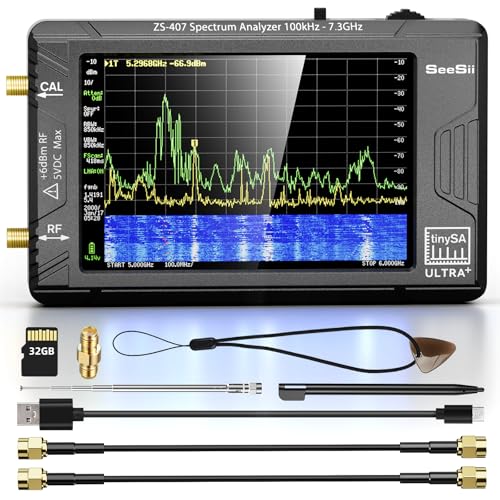
TinySA Ultra
$260.9
See all see signals in the frequency domain picks →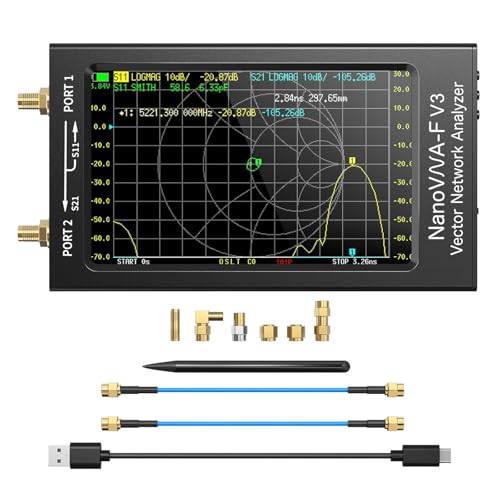
Sweep RF and antenna performance
NanoVNA-F V3
$299.99
See all sweep rf and antenna performance picks →Siglent SDS814X HD
Prices may change · Free shipping with Prime
◆ Design & Build Quality
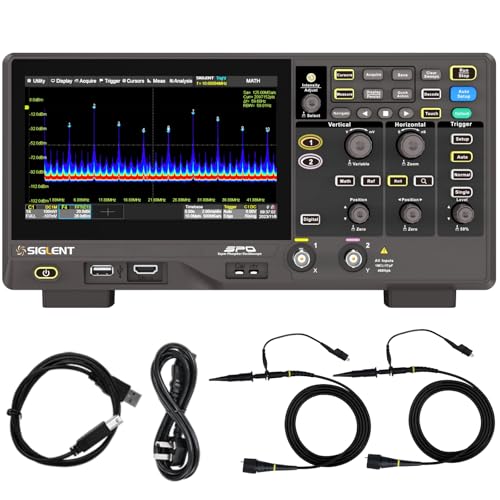
The SDS814X HD shares the chassis with the SDS804X HD: 312 x 151 x 133 mm, 2.6 kg. Same industrial design, same 7-inch IPS touchscreen layout, same physical control placement. If you've held an SDS804X HD, the SDS814X HD feels identical. Build quality is solid, with the rigid construction Siglent consistently delivers across their product line.
The 7-inch IPS touchscreen is the same panel used across the HD-series Siglents. Wide viewing angles, accurate colors, responsive multi-touch input, and 1024x600 resolution. The display is competitive with the Rigol DHO platform's panels and significantly better than the older Rigol DS1054Z TFT display. Multi-touch gestures (pinch to zoom, two-finger pan) work reliably.
The physical knobs and buttons follow Siglent's standard layout. Vertical scale and position per channel, horizontal scale and position, trigger level, and the usual function buttons (Run/Stop, Autoset, Single, Default, Save/Recall). Knob feel is good, with smooth rotation and clear detents. Button feedback is positive without being mushy.
The included probes are rated for 200 MHz, which provides comfortable headroom for the 100 MHz bandwidth and the unlock pathway. Probe compensation works smoothly with the scope's built-in test signal. For most hobbyist work, the included probes are adequate; upgrading to higher-quality probes only becomes necessary for specialized measurements.
Fan noise is similar to the SDS804X HD — present but subtle, ramping based on temperature. Several community members have noted Siglent fans tend to be quieter than equivalent Rigol DHO fans, though both are audible in completely silent environments.
The internal layout reflects Siglent's engineering quality. The analog front-end shielding, power distribution, and component selection all support the scope's clean noise floor performance. The LeCroy heritage in analog design shows through most clearly in measurements of low-amplitude signals, where the SDS814X HD's noise floor measurably outperforms equivalent-priced Rigol products.
◆ Performance & Specifications Deep Dive
The 100 MHz stock bandwidth is the SDS814X HD's primary differentiator from the SDS804X HD. The additional 30 MHz of headroom covers more of the embedded development frequency range without requiring the bandwidth unlock. Standard embedded signals — Arduino, ESP32, basic STM32 GPIO, typical SPI clocks — all fit comfortably within 100 MHz. Higher-speed embedded work (50+ MHz SPI clocks, fast STM32 variants, basic RF up to about 80 MHz) becomes more accessible.
Like the SDS804X HD, the SDS814X HD supports bandwidth unlocking via software license. The underlying hardware is the same; firmware sets the limit. With the unlock, the same scope provides higher bandwidth (typically 200 MHz). This provides a clear upgrade path if your work demands grow beyond 100 MHz over time.
The 2 GSa/s sample rate matches the SDS804X HD and exceeds the Rigol DHO platform's 1.25 GSa/s. At 100 MHz bandwidth, 2 GSa/s provides 20x oversampling for excellent waveform reconstruction. The Nyquist requirement is only 200 MSa/s, so the actual sample rate provides substantial margin.
The 50 Mpt memory depth captures 25 milliseconds at full sample rate — sufficient for complete protocol transactions, extended sensor monitoring, and detailed analog event analysis. This memory depth matches the Rigol DHO924S and exceeds the DHO814's 25 Mpt.
The 12-bit ADC is the SDS814X HD's strongest technical argument, identical to the SDS804X HD's converter. The clean noise floor (measurably lower than equivalent Rigol DHO scopes in independent benchmarks) provides genuine value for precision analog work. For audio characterization, power supply ripple analysis, low-noise signal measurement, and any application involving small AC signals on DC offsets, the SDS814X HD's measurement quality is the right choice.
The trigger system covers Edge, Pulse, Slope, Video, Window, Interval, Dropout, Runt, and Pattern triggers. Pattern triggering across 4 channels enables complex multi-signal trigger conditions. Runt and Dropout triggers are valuable for diagnosing signal integrity issues. The trigger flexibility is competitive with scopes costing significantly more.
For users coming from the SDS804X HD's 70 MHz, the 30 MHz bandwidth increase is the most tangible upgrade. For users comparing directly against the DHO924S, the bandwidth difference (100 MHz versus 250 MHz) is significant and weighs against the SDS814X HD on pure bandwidth metrics. The SDS814X HD's case rests on ADC quality, sample rate (2 GSa/s versus 1.25 GSa/s), and free LIN decoding.
◆ Software & User Experience
The SDS814X HD runs the same Siglent modern UI as the SDS804X HD and other HD-series scopes. The touchscreen-first interaction model is competitive with Rigol's UltraVision II — different visual language but similar capability and ease of use.
Menu navigation combines touch and physical controls effectively. The home screen displays active waveforms with measurement overlays; tapping any element brings up context-appropriate options. The interaction patterns are consistent with modern oscilloscope conventions, so users coming from any touchscreen scope adapt quickly.
Autoset works reliably across typical signal types. The implementation tends toward conservative voltage scaling (which is the right default), and timebase selection is generally appropriate. Manual fine-tuning after Autoset is occasionally needed but rarely extensive.
Math functions cover the standard set plus several useful additions. Standard arithmetic operations, FFT with multiple window functions, integration, differentiation, digital filtering, and the Bode plot analysis feature (when paired with an external signal source) for frequency response characterization. The Bode plot capability is genuinely useful for filter design, amplifier characterization, and control system work.
Automatic measurements support multiple simultaneous measurements with statistics. The measurement set is comprehensive — voltage parameters, time parameters, derived measurements, and signal quality metrics for digital signal analysis.
WiFi connectivity is included with browser-based remote access. The remote interface mirrors the scope's display and accepts touch input, supporting genuine remote operation. SCPI commands work over USB or LAN for Python and LabVIEW automation.
The protocol decoder configuration workflow is one of the SDS814X HD's UX strengths. Setting up SPI, I2C, UART, CAN, or LIN decoding is more streamlined than the Rigol equivalent, with sensible defaults that work for typical configurations. For users who decode protocols regularly, the workflow advantage adds up over many configurations.
Firmware update support has been active on the HD-series Siglents. Bug fixes, performance improvements, and occasional feature additions arrive through firmware updates. The SDS814X HD benefits from the same firmware pipeline as the rest of the HD line.
The Siglent community is smaller than Rigol's, which remains the platform's biggest non-technical drawback. EEVblog has substantial Siglent discussion, official Siglent forums have active engineer participation, and YouTube coverage is growing but still less than Rigol. For experienced users who need less community hand-holding, this is rarely a problem. For first-time scope buyers, the smaller community is a real consideration.
◆ Protocol Decoding & Mixed-Signal Capability
The SDS814X HD includes free protocol decoding for SPI, I2C, UART, CAN, and LIN. This matches the SDS804X HD and exceeds the Rigol DHO802/DHO814 (CAN-only, no LIN) and significantly exceeds the older DS1054Z (CAN/LIN require paid licenses). For automotive hobbyists and protocol-heavy users, the free LIN inclusion alone saves real money.
SPI decoding uses all 4 channels for clock, MOSI, MISO, and chip-select. At 100 MHz bandwidth, the decoder handles SPI clocks up to approximately 40 MHz reliably. With the bandwidth unlock to 200 MHz, this extends to roughly 80 MHz SPI. The 50 Mpt memory captures extended SPI transactions for analysis.
I2C decoding shows start/stop conditions, 7-bit and 10-bit addresses, data bytes with read/write interpretation, and ACK/NACK status. The search functionality lets you filter for specific addresses in busy multi-device networks. With SDA and SCL on two channels, two channels remain for context monitoring (interrupt lines, power, enable signals).
UART and RS232 decoding handle standard and arbitrary baud rates with both TX and RX simultaneously decodable on separate channels. The dual-channel decoding is essential for debugging command-response protocols.
CAN decoding handles standard and extended frame formats up to 1 Mbps. Frame ID filtering, data byte display, and error frame detection are all included. For OBD-II diagnostics, automotive electronics work, and CAN-based industrial protocols, the decoder is comprehensive.
LIN decoding handles standard LIN protocol frames at typical automotive speeds (10 kbps to 20 kbps). The free inclusion is meaningful for users working with LIN-based body electronics in modern vehicles. Rigol charges separately for LIN on most of their scope line.
The SDS814X HD supports optional 16-channel digital signal input via the SPL2016 logic probe (sold separately). When equipped, this turns the SDS814X HD into a true mixed-signal oscilloscope, with 16 digital channels and 4 analog channels for combined analog/digital signal correlation. For embedded debugging where you need to correlate analog sensor readings with digital protocol activity simultaneously, mixed-signal capability is genuinely transformative.
The Bode plot analysis feature, when paired with an external signal generator, automates frequency response characterization. Sweep a sine wave across a frequency range and the scope plots gain and phase response. For analog filter design, amplifier characterization, and control system work, this turns hours of manual measurement into automated capture.
Eye diagram analysis supports digital signal quality measurement for high-speed serial protocols. For users debugging signal integrity issues on differential pairs or serial buses, the eye diagram is the right diagnostic tool.
FFT analysis with multiple window functions provides basic frequency-domain visibility. For detailed spectrum work, a dedicated spectrum analyzer is still appropriate, but the FFT is competent for identifying dominant frequency components and verifying expected signal spectra.
◆ Real-World Use Cases
For precision analog work in the 70-100 MHz range, the SDS814X HD provides the bandwidth headroom and clean ADC needed for accurate measurement. Audio circuit design, op-amp characterization, low-noise signal analysis, and power supply ripple measurement all benefit from the 100 MHz bandwidth combined with Siglent's measurably lower noise floor.
For embedded development at higher signal frequencies, the 100 MHz bandwidth handles standard embedded work comfortably. ESP32, STM32 GPIO, typical SPI peripherals, and most analog sensor signals all fit within the bandwidth envelope. For higher-speed SPI (50+ MHz clocks) or fast microcontroller debugging, the 100 MHz is closer to the edge but still functional.
For automotive hobby work, the SDS814X HD's free LIN decoding is the standout feature. Modern vehicles use LIN for low-priority body electronics — door modules, seat controllers, climate control sub-systems. Free LIN decoding combined with free CAN decoding makes the SDS814X HD genuinely valuable for automotive electronics work without additional license fees.
For mixed-signal embedded work with the optional logic probe, the SDS814X HD becomes a comprehensive analog+digital debugging tool. The 16 digital channels plus 4 analog channels handle complex embedded scenarios — debugging FPGA designs interacting with analog sensors, characterizing motor control with PWM and current feedback, or analyzing communication protocols with related analog signals.
For educational use, the modern touchscreen interface lowers the learning curve. The 12-bit ADC reveals analog signal details that 8-bit scopes hide, which is pedagogically valuable. The free LIN decoding gives students exposure to automotive protocols without additional license fees. The smaller Siglent community is a minor consideration but offset by Siglent's comprehensive official documentation.
For power supply design, the SDS814X HD's clean noise floor combined with 100 MHz bandwidth provides genuine value. Switching frequency analysis, output ripple characterization, load transient response measurement, and high-frequency switching noise analysis all benefit from the measurement quality and adequate bandwidth.
For RF work below VHF, the 100 MHz stock bandwidth covers HF work comfortably (below 30 MHz) and supports lower VHF measurement (30-80 MHz). With the bandwidth unlock to 200 MHz, the SDS814X HD becomes a viable VHF measurement tool. For users with anticipated growth into RF work, the unlock pathway provides a future-proofing option.
For production test and characterization work, the SDS814X HD's combination of accurate ADC, deep memory, and comprehensive trigger system supports automated test sequences via SCPI. The mask testing capability supports go/no-go production verification.
◆ Who Should Buy This (And Who Shouldn't)
Buy the SDS814X HD if you need 100 MHz bandwidth with the option to unlock higher, prioritize measurement quality (clean ADC, low noise floor), and want free CAN/LIN decoding. For precision analog work or automotive hobby work in the 70-100 MHz signal frequency range, the SDS814X HD is well-positioned.
Buy it if you specifically need the bandwidth unlock pathway. The ability to upgrade to higher bandwidth via software license without buying a new scope is a unique advantage that no Rigol product matches. For users who anticipate future bandwidth needs, this future-proofing is valuable.
Buy it if you plan to add the optional 16-channel logic probe for mixed-signal work. The SDS814X HD's mixed-signal upgrade pathway turns the scope into a comprehensive analog+digital debugging tool. For embedded developers who need both analog and digital protocol visibility simultaneously, the mixed-signal capability is genuinely valuable.
Do not buy the SDS814X HD at $587 if your main need is raw bandwidth and you can stretch to the DHO924S around $899 for 250 MHz, a function generator, and CAN/LIN. The DHO924S's value proposition on pure bandwidth-per-dollar is strong, but the SDS814X HD remains the lower-cost option. The SDS814X HD only wins for users who specifically value Siglent's ADC quality or need the bandwidth unlock pathway.
Do not buy it if you only need 70 MHz bandwidth. The SDS804X HD at $461 provides the same ADC quality, same memory, same protocol decoders, and the same bandwidth unlock pathway for $126 less. The SDS804X HD is the better value if 70 MHz fits your work today.
Do not buy it if you want a built-in function generator. The SDS814X HD doesn't include one; you'll need a separate signal source. The DHO924S around $899 includes a 25 MHz function generator, saving both money and bench space.
Do not buy it if community documentation depth matters most. The Rigol DS1054Z's decade-deep community remains unmatched for first-time scope buyers learning electronics. Siglent's growing community is good but doesn't yet match Rigol's volume of tutorials and answered questions.
◆ Alternatives Worth Considering
The Rigol DHO924S around $899 is the strongest alternative for users who prioritize stock bandwidth and integrated features. 250 MHz versus 100 MHz is a significant bandwidth advantage, the included function generator is genuine value, and CAN/LIN decoding is included on the DHO924S as well. For general-purpose embedded work where you don't specifically value Siglent's ADC quality, the DHO924S wins on raw value.
The Siglent SDS804X HD at $461 is the price-down sibling. Same chassis, same ADC, same memory, same protocol decoders, same bandwidth unlock pathway — but 70 MHz stock bandwidth instead of 100 MHz. For users who fit within 70 MHz today, the SDS804X HD provides the same Siglent advantages for $126 less.
The Rigol DHO814 at $549 is the cross-brand competitor at a similar price. 100 MHz, 4 channels, 12-bit ADC, but with the smaller DHO800 form factor and USB-C power. The SDS814X HD beats the DHO814 on sample rate (2 GSa/s versus 1.25 GSa/s), memory (50 Mpt versus 25 Mpt), and LIN decoding inclusion. The DHO814 wins on form factor (more compact) and Rigol's larger community.
The Rigol DHO914S at $769 adds a built-in 25 MHz function generator and optional 16-channel logic probe to the DHO platform. For users who need mixed-signal capability and want a more compact form factor than the DHO924S, the DHO914S is a viable alternative. The SDS814X HD's mixed-signal pathway via the SPL2016 probe achieves similar capability for slightly less total cost.
For users with stretched budgets, the Siglent SDS2104X Plus around $1,400 is the upgrade path within Siglent's product line. 100 MHz stock bandwidth, 4 channels, 200 Mpt memory, and Siglent's premium feature set. For serious analog work, the SDS2104X Plus is a meaningful step up.
For users with smaller budgets, the Rigol DS1054Z at $349 is the budget-friendly alternative. 50 MHz stock (100 MHz hacked), 4 channels, 8-bit ADC, 12 Mpt memory, and the largest oscilloscope community on the internet. The trade-offs are real, but the value at $349 is hard to beat for first-time buyers.
Our Verdict
The Siglent SDS814X HD steps up to 100MHz from the SDS804X HD's 70MHz, keeping the same excellent 12-bit ADC, 2GSa/s sample rate, and 50Mpt memory. It competes directly with the Rigol DHO814 at a similar price point, and wins on sample rate and memory depth. The free CAN/LIN decoding is Siglent's consistent advantage over Rigol for automotive work. At ~$587 though, the value proposition gets complicated: the SDS804X HD below it is cheaper and unlockable, while the DHO924S sits higher as a premium 250MHz touchscreen upgrade. The SDS814X HD makes the most sense if you need that clean 12-bit Siglent ADC at 100MHz and want CAN/LIN decoding without additional license fees, particularly for automotive or precision analog work.
Siglent SDS814X HD
$587
Prices may change · Free shipping with Prime
◆ Full Specifications
| Full Specifications | |
|---|---|
| Bandwidth | 100MHz |
| Sample Rate | 2GSa/s |
| Channels | 4 |
| Memory Depth | 50 Mpts |
| Display Size | 7" |
| Display Type | IPS Touchscreen |
| Form Factor | Benchtop |
| Weight | 2.6kg |
| Dimensions | 312 x 151 x 133 mm |
| Protocol Decoder | SPI, I2C, UART, CAN, LIN |
| Function Generator | No |
| WiFi | Yes |
| Battery Option | No |
| Trigger Types | Edge, Pulse, Slope, Video, Window, Interval, Dropout, Runt, Pattern |
◆ Frequently Asked Questions
SDS814X HD or DHO924S?
Is the 30 MHz bandwidth bump from the SDS804X HD worth $126?
Can the SDS814X HD do mixed-signal analysis?
Is the bandwidth unlock to 200 MHz worth doing?
Does the SDS814X HD include a function generator?
How does the SDS814X HD handle CAN bus debugging?
Is the Siglent community big enough for support?
How does measurement quality compare to Rigol?
◆ Related Buying Guides
Compare With Similar Scopes
◆ Head-to-Head Comparisons
Siglent SDS814X HD
$587
Prices may change · Free shipping with Prime