◆ At a Glance
◆ Best For
◆ Overview
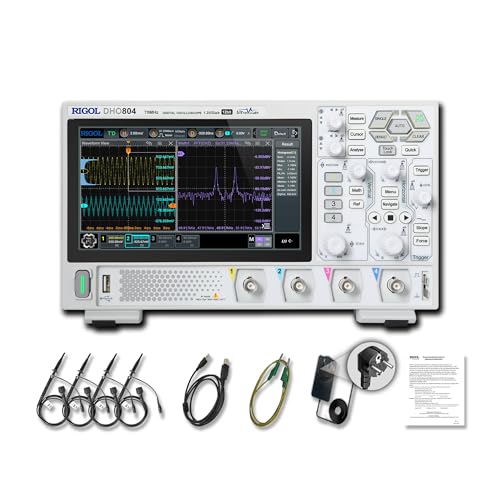
The Rigol DHO804 is the modern under-$500 Rigol scope that now makes the most sense for many hobbyists. At $439, it delivers 70 MHz bandwidth, 4 channels, a 7-inch IPS touchscreen, 25 Mpt memory depth, WiFi, and protocol decoding for SPI, I2C, and UART. Those are legitimately good specifications for a first serious bench scope.
The DHO924S used to sit close enough in price that it overshadowed the DHO804. That is not the current marketplace reality. With the DHO924S around $899, the DHO804 has clear daylight: it gives beginners and Arduino builders the same modern Rigol touchscreen workflow without jumping into premium pricing.
This review evaluates the DHO804 on its own terms. For basic Arduino work, learning electronics, audio projects, and sub-70 MHz signals, it handles the work well. The main tradeoffs are simple: no built-in function generator, no CAN/LIN decoding, and less bandwidth headroom than premium scopes.
◆ Pros & Cons
Pros
- 7-inch IPS touchscreen — same display as the DHO924S
- 25Mpt memory depth is solid for extended capture sessions
- Modern, intuitive interface makes learning easy
- 4 channels with protocol decoding (SPI, I2C, UART)
- WiFi connectivity for remote viewing and data export
Cons
- 70MHz bandwidth is the real compromise — limits this scope's ceiling
- No built-in function generator unlike the DHO924S
- 25Mpts memory is half the DHO924S's 50Mpts
- Stepping up to the DHO924S now costs substantially more
Core bench / four jobs
Build the signal path, not a pile of gear
A four-instrument path for observing, probing, checking, and generating without buying overlapping tools.
3 separate add-ons; one distinct job each
- 01See the signal
See the signal
Rigol DHO804
70 MHz · 4 channels · 25 Mpts
Selected scope - 02Reach the circuit
Reach the circuit
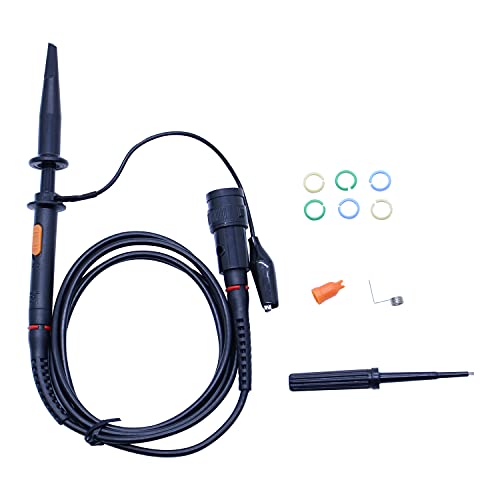
Hantek PP-250 (2-Pack)
250 MHz · 1X/10X switchable · 1.2 m lead
- 03Check voltage
Check voltage
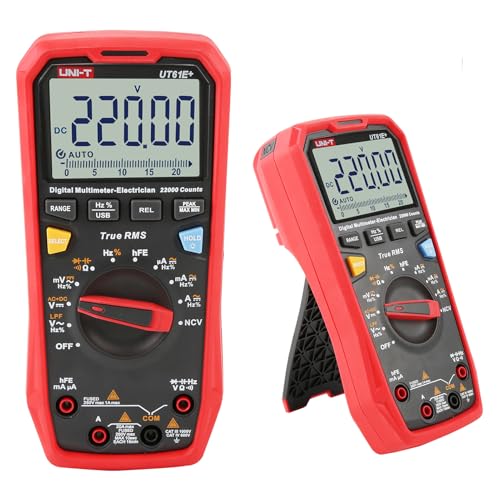
UNI-T UT61E+
true RMS · 22,000 count · capacitance · frequency
- 04Create a test signal
Create a test signal
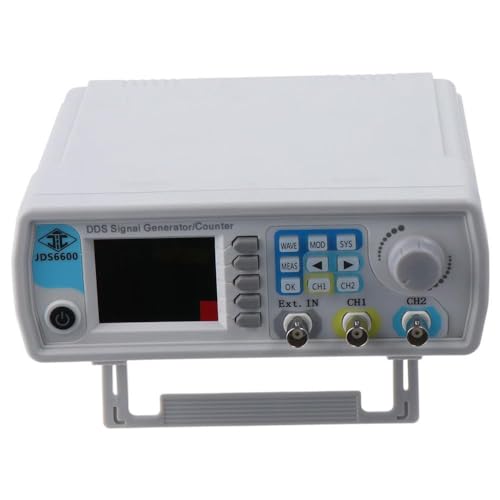
JDS6600 DDS Signal Generator
60 MHz · 2 channels · arbitrary waveform
Prices and availability can change. These are separate buying links, and each instrument uses its category-specific Amazon Associates tag.
Rigol DHO804
Prices may change · Free shipping with Prime
◆ Design & Build Quality
The DHO804 shares the DHO924S's physical chassis -- same 350 x 210 x 120 mm dimensions, same 3.8 kg weight, same industrial design. This means it gets the same solid build quality, the same comfortable form factor, and the same excellent 7-inch IPS touchscreen. Everything I said about the DHO924S's physical design applies identically here.
The IPS panel delivers good color accuracy, wide viewing angles, and responsive touch input. The 1024x600 resolution keeps text and measurement values crisp. Multi-touch gestures (pinch to zoom, two-finger pan) work reliably. The physical knobs for vertical scale, horizontal scale, and trigger level provide the same satisfying tactile control. If you've held a DHO924S, you've held a DHO804 -- there is no difference in the hardware feel.
The fan behavior is identical to the DHO924S -- present and audible in a quiet room but not distracting during normal work. The included probes are also the same standard Rigol probes, adequate for general work within the 70 MHz bandwidth but worth upgrading if you want to maximize measurement accuracy.
Where the design starts to feel limiting is in what's missing versus the DHO924S: no built-in function generator. This means you need a separate instrument for signal generation, which takes up bench space and adds to your overall cost. For a standalone bench scope, the missing function generator is noticeable. For users who already have a function generator or don't need one, it's irrelevant.
◆ Performance & Specifications Deep Dive
The 70 MHz bandwidth is the core specification that defines the DHO804's capability ceiling. For Arduino work at 16 MHz clock speeds, the 70 MHz bandwidth is more than adequate -- you're well within the passband with substantial headroom. For STM32 GPIO at 72 MHz, you're at the edge of the bandwidth and will see amplitude roll-off. For SPI at 25+ MHz clock speeds, you're working in a range where the bandwidth limitation starts to affect measurement accuracy.
To put this in practical terms: 70 MHz is enough for the vast majority of hobbyist Arduino and basic embedded work. It's not enough for faster microcontrollers, high-speed SPI, or any RF work. The DHO924S's 250 MHz bandwidth removes this ceiling almost entirely for hobbyist applications.
The 1.25 GSa/s sample rate is identical to the DHO924S and provides excellent oversampling at 70 MHz bandwidth. With Nyquist requiring only 140 MSa/s, the 1.25 GSa/s sample rate gives you nearly 9x oversampling, which produces very clean waveform reconstruction. This is actually better oversampling than the DHO924S achieves at 250 MHz (2.5x), so within its bandwidth, the DHO804's waveform quality is excellent.
The 25 Mpt memory depth is solid but half of the DHO924S's 50 Mpts. At full sample rate, 25 million points gives you 20 milliseconds of continuous capture. That's enough for most individual protocol transactions but may feel limiting for extended captures. If you frequently need to capture long sequences of bus traffic or monitor signals for seconds at a time, the memory depth difference between the DHO804 and DHO924S becomes meaningful.
The trigger system is identical to the DHO924S: edge, pulse, slope, video, pattern, duration, timeout, runt, window, delay, setup/hold, and Nth edge. This is one of the most comprehensive trigger systems at any price, and it's a genuine advantage of the DHO platform. Having pattern, runt, and setup/hold triggers at $439 gives you debugging capabilities that were exclusive to $2,000+ scopes a decade ago.
◆ Software & User Experience
The DHO804 runs the same UltraVision II firmware as the DHO924S, so the user experience is identical. The touchscreen interface is modern, intuitive, and responsive. Menu navigation is shallow and logical. Autoset is fast and accurate. The entire software experience that makes the DHO924S such a pleasure to use is present in the DHO804 as well.
Measurement configuration, automatic measurements, math functions, FFT, and cursor operations all work the same way. If you've read the DHO924S section of this review (or our DHO924S review), you know what to expect here. The interface is the best in our lineup for intuitive operation.
WiFi connectivity is included and works the same way -- browser-based remote access, screen capture, and data export over the network. This is a feature that the similarly-priced Siglent SDS1104X-U and the slightly cheaper Rigol DS1054Z don't offer, and it's a genuine convenience for remote monitoring.
PC connectivity via USB works with Rigol's UltraScope software for deeper analysis, screen capture, and remote control. SCPI support enables automation with Python, LabVIEW, and other tools. The SCPI implementation is the same as the DHO924S -- reliable and well-documented for the DHO platform.
◆ Protocol Decoding & Advanced Features
Protocol decoding on the DHO804 covers SPI, I2C, and UART. Notice what's missing compared to the DHO924S: CAN and LIN decoding are not included. This is a significant differentiator if automotive protocol work is in your plans. If you need CAN decoding, the DHO804 is not the right scope -- you need the DHO924S or the Siglent SDS1104X-U.
The SPI, I2C, and UART decoders work well within the 70 MHz bandwidth. SPI decoding handles clocks up to about 20-25 MHz comfortably, which covers most common SPI peripherals (sensors, flash memory, displays, ADCs). I2C decoding displays addresses, data, ACK/NACK status, and start/stop conditions clearly. UART decoding supports standard and non-standard baud rates.
The 4-channel capability is valuable for protocol work even at 70 MHz. SPI debugging requires clock, MOSI, MISO, and chip select -- exactly 4 signals. Being able to see all four simultaneously without swapping probes saves significant time during debugging sessions. Similarly, I2C debugging benefits from having SDA and SCL on two channels while monitoring power and an interrupt or enable signal on the remaining two.
The comprehensive trigger system works across all decoded protocols, letting you trigger on specific protocol conditions. Combined with the 25 Mpt memory depth, you can trigger on a specific I2C address and capture the surrounding context, or trigger on an SPI chip select edge and capture the entire transaction.
◆ Real-World Use Cases
The DHO804 is well-suited for Arduino and basic microcontroller projects. Verifying PWM output, checking I2C communication with sensors, debugging SPI connections to displays or SD cards, and monitoring GPIO states -- these are all tasks that the 70 MHz bandwidth and 4 channels handle comfortably. The touchscreen makes these interactions quick and intuitive, and the protocol decoding shows you the data flowing over the bus.
Educational use is another strong fit. If you're learning electronics, the touchscreen interface minimizes the time spent figuring out the scope and maximizes the time spent understanding signals. The autoset function quickly configures the scope for whatever signal you connect, letting you focus on what the signal looks like and what it means rather than how to display it.
Basic analog work -- audio circuits, op-amp configurations, filter design below 70 MHz -- is handled without issues. The 1.25 GSa/s sample rate provides excellent waveform quality at these frequencies, and the automatic measurements give you accurate frequency, amplitude, and timing data.
Where the DHO804 falls short is anything requiring more bandwidth or CAN/LIN support. SPI at higher clock speeds, faster microcontroller debugging, RF work, and automotive embedded development all push beyond what the DHO804 can do. For these applications, the DHO924S is the premium step up, while the SDS1104X-U is the lower-cost CAN/LIN alternative.
◆ Who Should Buy This (And Who Shouldn't)
Buy the DHO804 if you want a modern touchscreen scope under $500 and your work is mostly Arduino, ESP32, audio, education, basic analog, and normal embedded debugging. The 70 MHz bandwidth is enough for that world, and the 4 channels matter more than headline bandwidth for most beginner projects.
Buy it if you value ease of use. The touchscreen, autoset behavior, WiFi, and DHO platform workflow make it much easier to live with than older button-driven scopes.
Do not buy it if you need CAN/LIN decoding, a built-in function generator, or 200+ MHz bandwidth. Those are real limits. The Siglent SDS1104X-U is the better budget CAN/LIN pick, and the DHO924S is the premium Rigol bandwidth pick.
Do not buy it if the DS1054Z's community support matters more than a modern interface. The DHO804 is easier to use, but the DS1054Z still has the deepest tutorial base on the internet.
◆ Alternatives Worth Considering
The Rigol DHO924S at about $899 is the premium alternative. You get 250 MHz bandwidth, 50 Mpt memory, a function generator, and CAN/LIN decoding. It is a meaningful upgrade, but it is no longer a near-price sibling. Buy it when you actually need the extra bandwidth or mixed-signal feature set.
The Rigol DS1054Z at $349 is the alternative for budget-conscious buyers who want maximum community support. It offers 50 MHz bandwidth, 4 channels, 12 Mpt memory, and a massive ecosystem of tutorials, hacks, and forum answers. It lacks the touchscreen and modern interface, but the bandwidth hack to 100 MHz and the decade-deep community make it the safest learning pick.
The Siglent SDS1104X-U at $419 offers 100 MHz bandwidth with CAN/LIN decoding at a lower price than the DHO804. The trade-offs are a non-touch TFT display and a less intuitive interface. If automotive protocol decoding matters, the Siglent is worth considering over the DHO804.
The Siglent SDS804X HD at $461 is the closest 12-bit touchscreen competitor. It has a cleaner analog front end, 50 Mpt memory, and a bandwidth-unlock path. Choose it if precision analog measurement matters more than Rigol's user interface.
For users on a tighter budget, the FNIRSI 1014D and Hantek 6022BE are better-than-nothing options. Avoid treating older Hantek bench listings as budget buys unless the actual current price is below about $200.
Our Verdict
The Rigol DHO804 is the entry point to Rigol's DHO platform, offering the same 7-inch IPS touchscreen experience as the DHO924S with 70MHz bandwidth and 25Mpt memory at $439. For Arduino, basic analog work, and learning, 70MHz is genuinely sufficient — most signals you'll encounter stay well under this limit. The old objection was that the DHO924S cost almost the same; that is no longer true. With the DHO924S now priced like a premium scope, the DHO804 is the modern Rigol touchscreen pick for buyers who want a current interface without jumping near $900.
Rigol DHO804
$439
Prices may change · Free shipping with Prime
◆ Full Specifications
| Full Specifications | |
|---|---|
| Bandwidth | 70MHz |
| Sample Rate | 1.25GSa/s |
| Channels | 4 |
| Memory Depth | 25 Mpts |
| Display Size | 7" |
| Display Type | IPS Touchscreen |
| Form Factor | Benchtop |
| Weight | 3.8kg |
| Dimensions | 350 x 210 x 120 mm |
| Protocol Decoder | SPI, I2C, UART |
| Function Generator | No |
| WiFi | Yes |
| Battery Option | No |
| Trigger Types | Edge, Pulse, Slope, Video, Pattern, Duration, Timeout, Runt, Window, Delay, Setup/Hold, Nth Edge |
◆ Frequently Asked Questions
Should I buy the DHO804 or the DHO924S?
Is 70 MHz bandwidth enough for Arduino projects?
Does the DHO804 have the same touchscreen as the DHO924S?
Can the DHO804 decode CAN bus signals?
Does the DHO804 have a function generator?
How does the DHO804 compare to the DS1054Z?
Is the DHO804 worth buying for a teaching lab?
Will the DHO804's firmware improve over time?
◆ Related Buying Guides
Compare With Similar Scopes
◆ Head-to-Head Comparisons
Rigol DHO804
$439
Prices may change · Free shipping with Prime